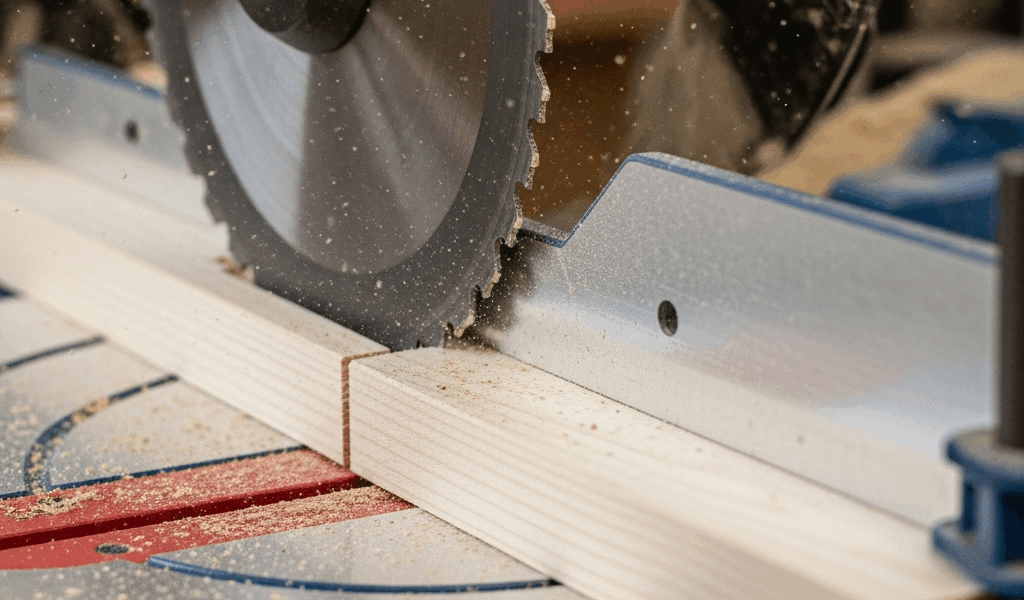
Why Miter Saws Bind During Cross Cuts
Blade binding in cross cuts—that sickening moment when the saw grabs the wood and either stalls or kicks back—feels nothing like normal cutting resistance. Binding is sudden, violent, feels like the blade is fighting the wood instead of slicing through it. Normal cutting resistance? That’s steady pressure. Binding is a trap.
The four most common causes, in order of how often I see them in the shop, are: a fence that’s not square to the blade, a dull blade that’s lost its cutting geometry, stock that isn’t sitting flat against the fence, and blade runout from worn spindle bearings. Most people jump straight to replacing the blade. I’ve swapped blades a dozen times before realizing the fence was out by 2 degrees. Wrong move.
Quick Fence Square Check You Can Do Right Now
Stop what you’re doing. Grab a combination square or a reliable 12-inch metal straightedge. Lower the blade all the way down without cutting anything—just let it rest against the table. Place your square against the blade body, not the teeth, and check the gap between the blade and the square’s edge. If there’s light showing, your fence isn’t square.
Here’s what binding feels like during the cut when your fence is out of square: the saw hesitates as the blade enters the wood, the motor pitch changes—sounds like the blade is straining—and the cut line drifts. You might see a thin plume of smoke. The kickback risk is real. I learned this the hard way with a DeWalt DWS779 that I inherited from my father-in-law. Three months of thinking the blade was trash, then I squared the fence and everything changed.
To adjust, loosen the fence bolts (usually 10mm or 12mm on most models) and tap the fence base with a rubber mallet until the square shows zero gap. Tighten it down firm. Make a test cut on scrap—a 2×4 works fine. The cut should be silent except for the normal blade whine. The kerf should be straight with no hesitation. Still binding? Move to the blade check.
Blade Inspection Checklist Before You Buy New
A dull blade doesn’t always bind—it cuts slower and requires more pressure, which feels different. True binding from a dull blade shows up as gumming, where resin and wood dust cake up on the flank of the teeth. Look at the blade closely under shop light. The teeth should have a sharp edge that reflects light like a mirror. If the teeth look rounded or dark, or if there’s a buildup of dried wood residue on the tooth face, the blade is done.
Bent teeth are your smoking gun. Spin the blade by hand — unplug the saw first, this is obvious but I’ve seen it happen — and watch the tip of one tooth as it rotates. If it wobbles or moves toward and away from a fixed point like a pencil held near the rim, you have runout. A wobbling blade will bind unpredictably. That’s the blade’s fault, not the fence.
Heat discoloration is your next clue. Look at the blade body—not the teeth, but the steel between teeth. If it has a blue or purple tint, the blade overheated during a cut. That usually means you were pushing too hard, but it also means the blade has lost temper and should be retired. A quality 10-inch crosscut blade like a Freud D1080X costs about $35 to $50, and new blades are less aggravating than blades on their way out.
The pencil trick works better than guessing: hold a mechanical pencil point near the spinning blade at a safe distance. As the blade rotates, the pencil marks the blade if there’s wobble. More than a hair-width of movement means you’ve got bearing play. That’s not something fence adjustments fix.
Stock Prep and Fence Seating That Stops Binding
Here’s where most DIY folks miss the diagnosis entirely—the wood itself can cause binding even with a square fence and sharp blade. When you push a board against the fence, you’re assuming it sits flat. It usually doesn’t. Cupped boards, ones that curve like a bowl, will rock. One corner of the board touches the fence, the other doesn’t. As you cut, the blade binds against the high side of the cup.
Run your straightedge along the back side of every board before cutting. If there’s daylight under the edge, find another piece or plane it flat. For bowed wood — curved along the length — position the board with the bow facing away from the fence so the flat side seats tight. With a miter saw, you’re cutting perpendicular to the grain, so the edge has less room for deviation. Spend 30 seconds checking the fit before the cut.
Pressure points matter too. Push the stock against the fence firmly but not aggressively—you’re seating it, not crushing it. Some miter saws have adjustable fence facings. If yours does and binding is intermittent, wipe the fence face with a dry cloth to remove dust, then apply a light coat of PTFE dry lubricant, like Dupont Teflon spray. Not wax—wax is sticky. Dry PTFE lets the wood slide without resistance. One $8 can lasts a year in the home shop. I’m apparently someone who underestimates fence maintenance and this spray works for me while paste wax never does. Probably should have opened with this section, honestly. It stops phantom binding faster than anything else.
When Binding Means It’s Time to Service Your Saw
Squared the fence? Inspected the blade? Checked the stock? Binding still happens only at certain blade heights or with light cuts? The problem is inside the saw. Spindle bearing play doesn’t show up visibly—you feel it. The blade wobbles, and binding is random. This isn’t a DIY fix. Spindle bearings on a miter saw like a Makita LS1018L or Bosch MS12S cost $40 to $80, but the labor to swap them is 2 to 3 hours if you’re careful.
Call a tool service center instead. A spindle bearing service runs $120 to $200. It’s less than a new saw and more reliable than replacing consumables that aren’t the problem. I once replaced three blades in a month before a technician spent 45 minutes replacing a $12 bearing. Don’t make my mistake.
The binding trap is this: you blame the tool when the tool is blameless 80 percent of the time. Start with the fence. Move to the blade. Check the wood. Only then blame the mechanics. Follow this order and you’ll spend your money on actual wear items instead of panic purchases.




Stay in the loop
Get the latest the home woodshop updates delivered to your inbox.