“`html
Plywood vs Solid Wood for Cabinet Making — What Actually Matters in Your Workshop
Cabinet building has gotten complicated with all the material noise flying around. I’ve been at this for eight years, and I still field the same question almost weekly: plywood or solid wood? Here’s what I’ve learned the hard way—both belong in your shop, and picking wrong for your specific build will either drain your wallet or waste your time. This isn’t a “one is better” situation. It’s about matching material to project, budget, and climate.
Let me walk through the real tradeoffs.
Cost Comparison — Solid Wood vs Plywood
Pricing is where most people start, and for good reason. Materials eat 30–40% of a cabinet build’s cost.
Solid wood pricing depends entirely on species. Pine runs $1.50–$3.00 per board foot rough-sawn from a local mill, or $4–$8 finished from a big-box store. Red oak comes in around $2–$4 board feet rough, $6–$12 finished. Maple and birch — the workhorses for visible cabinetry — run $3–$6 rough and $8–$15 finished. Walnut hits $8–$15 rough. These prices shift constantly. I bought red oak at $6.50/bf in January and paid $9.20/bf three months later. That’s the lumber market in a nutshell.
Here’s the painful part: waste. Most woodworkers budget 20–30% material loss from milling, jointing, planing, and ripping. A typical 3×8′ cabinet face frame in oak requires roughly 40 board feet of lumber to yield 30 usable feet. Do the math. At $8/bf, that’s $320 for material that becomes $240 of actual cabinet.
Plywood costs differently. A 3/4″ birch plywood sheet (4×8′) runs $45–$65. Maple veneer plywood is $55–$75. Oak veneer hits $40–$50. For a cabinet carcass measuring 36″ wide × 24″ deep × 36″ tall, you’re looking at roughly one sheet — maybe $50–$70 in material, with nearly zero waste if you plan cuts carefully.
The labor time difference is stark. Milling solid wood for a cabinet face frame takes 6–10 hours. Rough stock sits in your shop acclimating, then jointer, planer, table saw, edge joining. Plywood requires 2–3 hours of cutting, edge banding application, and layout. That’s the real math: solid wood saves maybe $30 in material but costs you a full day of shop time at whatever your hourly rate is.
Bulk pricing helps solid wood slightly. Buy 500 bf of oak, and mills drop the price 15–20%. But that requires capital, storage space, and climate control — things most home shops don’t have.
Workability and Joinery Differences
Probably should have opened with this section, honestly. It matters more than price for actual build quality.
Solid wood is straightforward to join. Mortise and tenon? The wood fibers hold mechanical strength throughout the joint. Pocket hole screws? They bite aggressively into solid grain. Edge-to-edge glue joints create a seamless surface. I’ve built face frames from quarter-sawn oak that have zero visible seams after 15 years. That’s what makes solid wood endearing to woodworkers who care about longevity.
Plywood presents specific challenges. Mortising into plywood is risky — the veneer layers don’t hold mechanical strength the way end grain does. A mortise in 3/4″ birch plywood means you’re relying on whatever veneer happens to be facing the joint, plus whatever cross-banding is underneath. I’ve had mortises split out under clamp pressure. Pocket holes work fine if you’re holding them in the interior plies, but drilling through face veneer risks tear-out. The MDF or poplar core doesn’t hold screws as aggressively as hardwood — you need pilot holes and careful torque control.
This is where edge banding enters the picture. You cannot avoid it with plywood cabinet doors and face frames. Edge banding is 3/4″ iron-on or glue-applied veneer that covers the ply edge. It’s essential — exposed plywood edges look unfinished — but applying it well requires practice. Cheap edge banding (polyvinyl chloride) peels after two years. Quality edge banding in matching species (veneer tape from Woodworkers Source or similar) costs $0.40–$0.80 per linear foot. A 36″-wide cabinet with four edges runs $4–$6 in material plus 45 minutes of application work per piece.
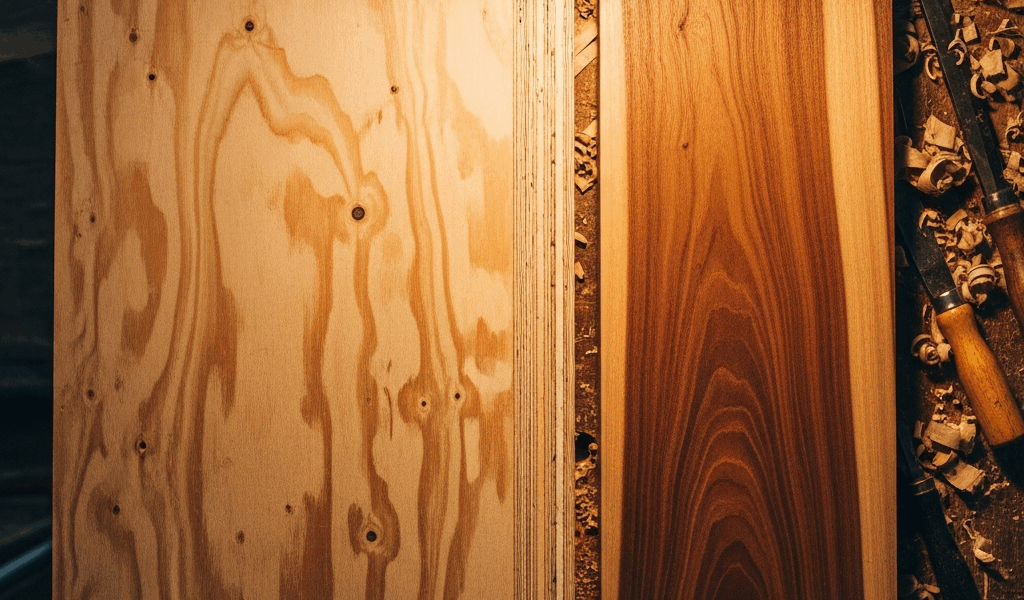
Solid wood’s weakness is movement. Wood moves across the grain seasonally — roughly 0.2% per 1% change in relative humidity. A 24″ wide cabinet side in solid oak expands and contracts 0.05″–0.10″ across its width annually in climates with 30–50% RH swings. Plywood barely moves because the cross-laminated construction cancels grain direction. In Arizona or Minnesota, that movement matters. In coastal California or the Pacific Northwest? Less pronounced.
Finishing Solid Wood vs Veneer Surfaces
Sanding solid wood takes longer but feels more forgiving. You’re cutting away surface fuzz and minor dings with the grain. Eighty-grit, then 120, then 150, then 180 if you’re painting or staining. Total time: 90 minutes for a cabinet side.
Plywood veneer is thinner — birch face veneer is typically 1/32″ thick. Sand too aggressively and you sand through. I’ve done this. Twice. Now I use 150-grit as my starting point and finish with 180. Time: 45 minutes, but the margin for error is tighter. Don’t make my mistake.
Staining exposes another gap. Solid wood absorbs stain fairly evenly if you’ve milled it properly from the same species batch. Paint grade solid wood (pine, poplar) accepts stain inconsistently because softer earlywood absorbs faster than latewood. You have to pre-condition with dilute stain or sanding sealer. Plywood veneer stains more uniformly because the veneer is sliced from one log, so grain character is consistent across a sheet. But plywood edges — even banded edges — will stain darker than the face because you’re hitting raw wood (under the veneer tape) or MDF core. You have to sand and seal edges separately.
Clear finishes (poly, lacquer, varnish) are straightforward on either material. The difference is wood grain visibility. Solid wood shows growth rings, figure, grain variation — character. Plywood shows what the veneer shows, which is either beautiful (figured maple veneer) or flat (plain-sawn birch). You don’t get to play with grain character the way you do with hand-selected solid boards.
Durability and Long Term Stability
Kitchen cabinets live in high-humidity environments. Solid wood expands and contracts seasonally. Doors that fit perfectly in January might stick in July. Drawer sides can bow. Face frames can twist if the wood was poorly milled or the species has high movement — white oak is terrible for this; cherry is better.
Plywood in a kitchen stays flat. The cross-laminated construction resists humidity-induced movement. Cabinet sides don’t bow. Shelves don’t sag. This is why commercial cabinetry manufacturers use plywood — consistency and flatness matter more than character.
But plywood has its own durability problem: delamination. If water gets between veneer layers, the glue fails. I’ve seen a kitchen island where the sink was poorly sealed and water wicked up through the plywood side. Six months later, the veneer was separating from the core. Solid wood swells and shrinks, but the whole mass moves together. You can’t delaminate.
Delamination happens slowly, usually over 5–10 years of poor sealing or chronic humidity exposure. It’s mostly preventable with proper edge banding, careful glue-up, and sealing any exposed plywood edges. But it’s a real risk that solid wood doesn’t carry.
Plywood face veneer durability depends on quality. Cheap box-store birch plywood has veneer so thin that dings and scratches are permanent. Good quality veneer (3-ply birch from a specialty supplier) resists damage better. Still, if you’re building cabinetry your grandkid might inherit, solid wood feels safer.
When to Choose Each Material
So, without further ado — here’s the practical decision tree I use:
Choose solid wood for: Heirloom pieces, visible show wood where grain character matters, face frames you’ll see every day, open shelving, any cabinet where movement won’t cause function problems, projects where budget allows and timeline permits. Estimate 40–50% longer timeline.
Choose plywood for: Kitchen and bathroom cabinets in humid climates, built-in shelving where flatness matters more than character, painted cabinetry (you don’t see the material), carcass backs and interior panels, shop storage and workbenches, any project where you need quick turnaround, custom cabinetry on a client timeline, shelves longer than 30″ that need to not sag.
Mixed approach — this is what I do now. Plywood carcass and shelves (solid, stays flat) plus solid wood face frame and doors (visible, movable parts that need mechanical strength in joints). Hybrid builds cost less than all-solid but look better and function better than all-plywood. A 36″-wide, 24″-deep, 36″-tall cabinet with four doors costs roughly $120 in plywood carcass materials and $180 in oak face frame and door stock. All solid wood hits $280–$320. All plywood with quality edge banding runs $100–$140.
Budget-conscious builders should plywood the carcass and edge-band everything. Skill-focused builders should consider solid wood face frames even if the box is ply. Time-constrained builds go full plywood. Heirloom pieces go solid throughout. Kitchen cabinets? Plywood carcass, solid doors — because kitchens move, and doors need to work in five years.
“`

Stay in the loop
Get the latest the home woodshop updates delivered to your inbox.