“`html
What Router Chatter Actually Is and Why It Happens
Router bit chatter and tearout on hardwood edges get tangled up constantly. Let me untangle them for you.
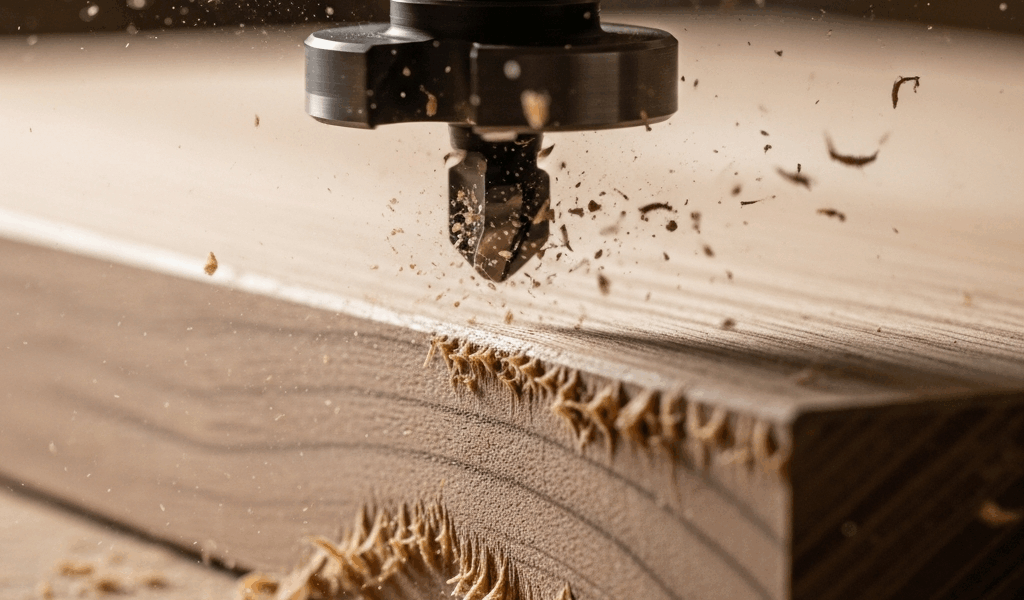
That repetitive vibration you hear — a rapid clicking or juddering sound — that’s chatter. It happens when the bit bounces against the wood instead of slicing cleanly through it. Tearout is different. It’s the splintered, ragged grain that lifts away from the surface, usually at the exit edge of your cut. You can get one without the other, though they often show up together on hardwoods like oak and hard maple.
But what is chatter, really? In essence, it’s a vibration problem. But it’s much more than that. When your router bit enters the wood, it needs to cut decisively. If something interferes with that clean engagement, the bit deflects sideways — even a few thousandths of an inch. That deflection causes the bit to lose contact momentarily, then slam back into the wood. Repeat that hundreds of times per second and you’ve got chatter. The bit is oscillating instead of rotating in a stable plane.
Probably should have opened with this section, honestly, but the root causes matter more than the definitions. Chatter almost always traces back to one of three culprits: feed speed that’s too slow, a worn or dull bit, or spindle runout from a loose collet or worn bearings. Sometimes it’s two of them working together, which is why diagnosis matters.
I learned this the hard way during a cherry cabinet job three years ago. I blamed my router for six hours before realizing the bit was moving around inside a worn collet like a penny in a tin can. Once I focused on the diagnostic process instead of guessing, the fix took fifteen minutes. Don’t make my mistake.
Step 1: Diagnose Feed Speed Problems First
Feed speed is the most common cause, so start here.
When you push your router bit through wood too slowly, the bit spins in place longer than it should. Instead of slicing, it starts rubbing and generating heat. Rubbing causes friction, friction destabilizes the bit, and instability creates chatter. This happens especially on hardwoods because their grain density resists the bit more than softwoods do.
Oak and hard maple are notorious for this. The bit wants to move through faster than your hand naturally pushes it. You end up creeping along at what feels safe, but paradoxically, slower feed speed makes chatter worse.
So, without further ado, what’s the right feed speed? Here’s a practical formula: multiply your bit diameter in inches by your spindle RPM, then divide by 4,000. That gives you a baseline feed rate in inches per minute.
For example, a half-inch bit at 18,000 RPM: (0.5 × 18,000) ÷ 4,000 = 2.25 inches per minute. That sounds glacial if you’re used to guessing, but on hardwoods it’s realistic. A three-quarter-inch bit at 12,000 RPM: (0.75 × 12,000) ÷ 4,000 = 2.25 IPM again.
Here’s the catch: you can’t measure inches per minute by watching your hands. But you can use the results as a sanity check. A three-inch-per-minute cut is steady, confident, and feels intentional — not rushed. If your instinct says “move it faster,” you’re probably right. If your instinct says “hang on, let the bit do the work,” you’ve found the sweet spot.
Depth of cut changes everything. A half-inch deep cut demands slower feed than a quarter-inch cut in the same wood. When chatter starts, reduce depth first before you assume the feed speed formula is wrong. Taking two shallow passes instead of one aggressive pass eliminates most chatter on hardwood edges.
Step 2: Check Bit Sharpness and Wear
Dull bits chatter because they can’t cut cleanly. Instead they abrade.
A sharp edge parts the wood fibers. A worn edge crushes them and creates friction. Friction equals heat, vibration, and those telltale burned marks along the cut edge. See a dark brown or black char line on the router cut? That bit is worn.
Another sign — the exit edge of your cut looks fuzzy or feels rough to your fingernail. A sharp bit leaves a surface you can almost polish. A dull bit leaves something between a cut and a sanded surface. Splintered, dull, and fragile.
Worn bits also chatter because the blade deflects more easily. Steel loses its hardness near the cutting edge as it wears. The bit becomes more flexible, which means it vibrates more under the same feed pressure.
Replacement or resharpening costs about $15 to $40 per bit for professional sharpening, or $8 to $25 for a new consumer-grade bit from the big-box stores. That’s what makes bit replacement endearing to me — compare that against an hour of your time troubleshooting chatter that was never a feed speed problem. It’s usually worth just replacing the bit and moving on.
I’ve made the mistake of resharpening bits multiple times instead of buying new ones. Resharpened bits worked okay, but they chattered more than fresh ones from the start. The metal structure changes during heat treatment. Now I sharpen only my premium bits — the $40 Whiteside models — and replace the $10 ones. It saves time and frustration.
Step 3: Test Spindle Runout and Collet Grip
Spindle runout is the wobble in your router’s spindle. Even a tiny amount — half a thousandth of an inch — creates chatter on hardwoods.
The simplest test requires a dial indicator and a magnetic stand. Mount the indicator so the probe touches the shank of your bit about two inches below the collet. Zero the dial, then rotate the spindle by hand (power off!) and watch the needle. Any deviation means runout. If the needle swings more than 0.003 inches, you have a problem.
But most home shops don’t have a dial indicator handy. Here’s the visual test: chuck a straight bit in your collet, run the router at full speed with no wood contact, and watch the bit tip. A bit with runout traces a small circle instead of staying in one place. It’s visible if you get close enough — look from the side and slightly above.
Before you assume spindle bearing failure, check your collet first. Cheap collets and loose bits cause 80% of runout problems I’ve diagnosed.
Pull the bit out and inspect the collet for dust, resin buildup, or corrosion. A toothbrush and mineral spirits clean out most debris. Then reinsert the bit firmly — it should slide in and sit flush with the collet nut. If it’s loose or won’t seat, the collet itself needs replacement. Collet replacements run $15 to $40 and take five minutes to swap on most routers.
Tighten the collet nut snugly. Not gorilla-tight, but firm enough that the bit won’t budge. A loose bit will dance around inside the collet and chatter violently. A properly seated bit in a clean collet solves runout-induced chatter in most cases without any spindle bearing work.
Quick Fixes You Can Try Today
Ranked by ease and safety:
- Increase feed speed slightly. If you’ve been creeping along at a hesitant pace, try pushing the bit through 20% faster than feels comfortable. Hardwoods respond dramatically to this adjustment. You’ll hear the chatter smooth out in seconds.
- Clean your collet. Compressed air and a brass brush take two minutes. This alone fixes more chatter than any other single step.
- Reduce depth of cut. Instead of removing half an inch in one pass, take two quarter-inch passes. Each pass chatters less because the bit deflects less under reduced load.
- Replace the bit. If the edge looks burned or the cut feels fuzzy, put a fresh bit in the collet. Even a $12 replacement beats six hours of diagnostics.
- Add a backer board. Clamp a scrap of hardwood behind (or below, depending on your setup) your workpiece. The backer prevents tearout by giving the bit a solid surface to exit into instead of splintering the far edge. This is especially useful on table-mounted routers where the bit exits through the bottom of the stock.
- Slow the spindle RPM. Most home routers run 18,000 to 24,000 RPM by default. Try dropping to 12,000 RPM on half-inch bits and larger. Slower rotation reduces vibration energy. On smaller bits — quarter-inch and under — keep the speed up. They need the RPM to cut efficiently.
- Try a climb cut cautiously. Normally you feed against the bit rotation (conventional cut), but a gentle climb cut — feeding with the rotation — can reduce tearout on exit edges. This requires a very light hand and good control; it’s riskier on handheld routers because the bit wants to pull itself forward. Use it only after mastering the safer options.
Start with feed speed and collet cleaning. Those two fixes resolve chatter in eight out of ten situations I’ve encountered. If chatter persists after those, move to bit replacement and depth adjustment. Only after eliminating those three causes should you suspect spindle bearing issues.
Test one variable at a time so you know what actually fixed it. Change feed speed while keeping RPM constant. Change bit while keeping feed and RPM the same. This discipline saves frustration on your next project because you’ll remember what worked.
“`


Stay in the loop
Get the latest the home woodshop updates delivered to your inbox.