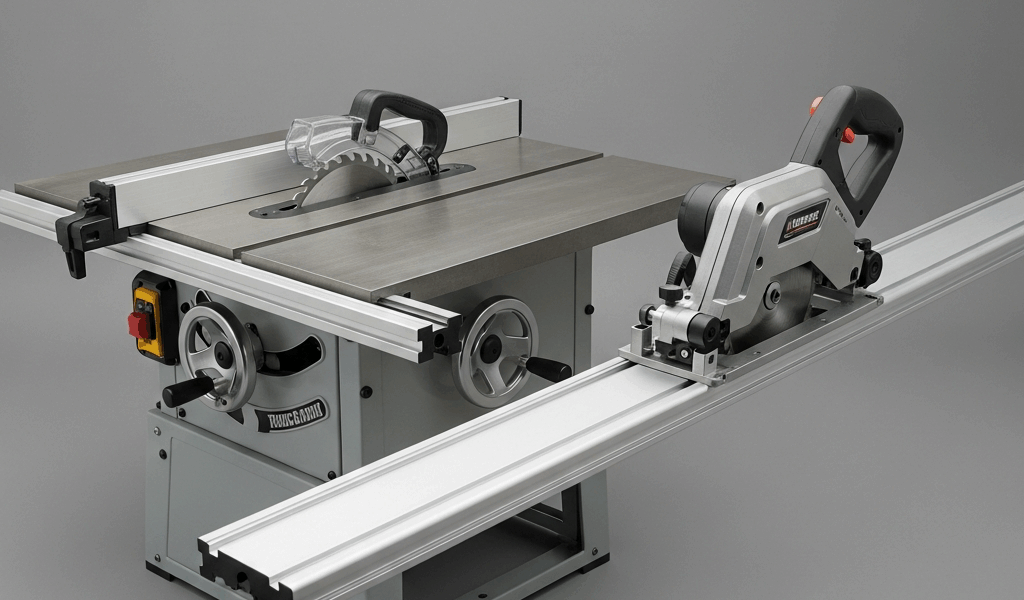
Table Saw vs Track Saw — Which One Do You Actually Need
The table saw vs track saw debate has turned into a moving target with all the forum noise flying around — and most of it dodges the actual question. People aren’t asking which tool a professional cabinet shop would choose. They’re asking which one makes sense when you’ve got one slot in the garage and maybe $600 to spend.
This article includes affiliate links. We may earn a commission at no extra cost to you.
As someone who owns both a SawStop Contractor saw and a Festool TS 55 REQ and runs them almost every week, I put in the hours studying this specific decision. They are not interchangeable. Here’s how I actually think about it.
The Quick Answer — Buy a Table Saw First (Usually)
Build furniture? Cabinets? Boxes? Frames? Anything that involves milling solid lumber? Buy a table saw. Full stop. It’s the more versatile machine for general woodworking — and that versatility comes from a handful of specific capabilities a track saw simply can’t touch.
Rip cuts on solid wood are the obvious one. Running an 8-foot board of hard maple through a table saw with the fence locked at 2.5 inches is fast, repeatable, dead accurate. Forty cuts in a row — every piece identical. Try that with a track saw and you’re clamping and repositioning a guide rail for every single cut. Painful doesn’t cover it.
Then there are dadoes. A track saw cannot cut dadoes — full stop. A table saw with a dado stack cuts grooves, rabbets, and housing joints that are fundamental to cabinet and furniture construction. I use my dado stack probably three or four times a week. There’s no real workaround here with a track saw. You’d need a router table instead, which is a whole separate tool and a whole separate workflow.
Small parts are another area where the table saw just wins. Crosscutting narrow pieces, trimming drawer fronts to final dimension, running repeated cuts on short stock — the table saw handles all of it with a sled or miter gauge. A track saw needs room to run. Short pieces and a track saw are awkward at best, genuinely annoying at worst.
- Ripping solid lumber to consistent widths
- Dado and rabbet cuts with a stacked dado set
- Repetitive crosscuts using a miter gauge or crosscut sled
- Milling small parts safely and consistently
- Bevel cuts on narrow stock
That’s what makes the table saw endearing to us furniture builders. Most shop workflows radiate outward from it — and that’s not an accident.
When a Track Saw Is Actually Better
Worth putting near the top. Because there are real scenarios where a track saw isn’t just equal to a table saw — it’s genuinely better. Skipping over those doesn’t help anybody.
First scenario: a small shop. A contractor table saw eats floor space. You need infeed room, outfeed room, room to maneuver. Breaking down a 4×8 sheet of 3/4-inch plywood on a table saw requires either a large outfeed table or a second set of hands. My shop is 18 by 22 feet — sounds reasonable until you’ve got a table saw, a workbench, a bandsaw, and a drill press all fighting for the same square footage. Wrestling a full sheet in that situation is genuinely miserable. With a track saw, I lay the sheet on foam insulation blocks on the floor, clamp the Festool rail across it, and make a clean cut. No drama.
Second scenario: a shop built almost entirely around plywood and sheet goods. Flat-pack furniture, cabinet carcasses from sheet stock, built-ins — if most of your material starts as 4×8 panels, the track saw workflow is faster and less physically punishing than fighting sheets through a table saw.
Third scenario: job site work. A track saw and two guide rails fit in a bag you can carry with one hand. A table saw does not travel that way. Flooring installs, built-in cabinets, trim carpentry — a track saw starts looking close to essential pretty quickly.
- Shop under 200 square feet with limited maneuvering space
- Work that is 80 percent or more sheet goods
- Regular job site or on-location work
- Situations where setup time needs to be minimal
Frustrated by a cramped garage and a plywood cabinet project that kept going sideways, I borrowed a friend’s Makita track saw for a weekend and cut an entire kitchen cabinet carcass from three sheets of Baltic birch — using the floor setup, foam blocks, the whole thing. Faster than my table saw workflow by a significant margin for that specific job. Learn from what tripped me up of dismissing it just because it looked like a fancy circular saw.
Cut Quality Comparison
This one caught me off guard when I started paying close attention. On sheet goods specifically, a track saw produces a cleaner cut than most table saws — at least without serious setup work on the saw side.
The splinter guard on the guide rail is why. That rubber strip along the edge of a Festool or Makita rail compresses against the face of the plywood right at the cut line. The blade exits the material into that compressed rubber, which supports the wood fibers right up to the moment of separation. The result looks almost like a factory edge — clean enough on good plywood that you could honestly skip the edge banding if you weren’t too precious about it.
Getting that same quality from a table saw requires two specific things: a quality blade and a zero-clearance insert. The zero-clearance insert supports the wood fibers from below the same way the rail’s rubber strip does from above. With a good 80-tooth ATB blade and a proper throat plate, a table saw can produce very clean cuts in plywood. But you have to make the zero-clearance insert yourself — or track one down for your specific saw model — and you have to know that it matters. Out of the box, most contractor saws will tear out melamine and veneer plywood without mercy.
Scoring Cuts
But what is a scoring cut? In essence, it’s a very shallow first pass — maybe 1mm deep — before the full-depth cut follows. But it’s much more than that. On a Festool TS 55 or TS 75, this scoring function virtually eliminates tearout on the bottom face of the material. No consumer or prosumer table saw does this. It’s a genuine technical advantage, not a marketing feature.
Ripping Solid Lumber — Cut Quality
Flip the question around for solid wood and the table saw wins cleanly. A rip blade leaves a surface that needs minimal cleanup — sometimes just a light pass through a thickness planer, sometimes a few swipes with a hand plane. A track saw ripping solid lumber is functional, sure, but the cut surface is rougher and the whole process is slower and harder to control. It wasn’t designed for it. You can feel that immediately.
Safety Comparison
Being direct here. The table saw is a more dangerous tool — and anyone who waves that off with “just respect the tool” is being dismissive of something that actually sends people to emergency rooms.
Kickback is the specific hazard. When a workpiece gets pinched between the blade and the fence, or when the wood moves as the cut relieves internal tension, the saw can throw material back at the operator with serious velocity. It’s happened to me twice. Once with a piece of reclaimed oak that wasn’t as flat as I thought — nothing hit me, but the piece traveled eight feet across my shop and took a chunk out of my dust collector. A riving knife — or a splitter at minimum — is mandatory. Not optional. Not situational. Every single cut.
A track saw, by contrast, has a blade that’s fully enclosed except at the cut. The plunge mechanism means the blade isn’t exposed while you’re positioning the tool. There’s no table to trap a workpiece against. Kickback in the traditional table saw sense essentially doesn’t exist. For a beginner, or for someone who doesn’t cut wood regularly enough to keep their habits sharp, this is a meaningful difference — not a minor one.
Track saws aren’t without risk. The blade is spinning. You can absolutely cut yourself. But the specific catastrophic-injury scenario that woodworkers fear most simply isn’t part of the track saw picture.
Cost Analysis — Total Investment
The price tags look similar at first glance. Dig into what you actually need to be productive with each tool and the picture gets more interesting.
Entry-Level Table Saw
A decent contractor-style table saw — the DeWalt DWE7491RS is the common starting point — runs $550 to $650 new. That gets you a rolling stand, 32-inch rip capacity, and a functional fence. Add a quality combination blade immediately because the included blade is mediocre at best — budget $60 to $90 for a Freud LU83R010 or a Diablo 10-inch. A zero-clearance insert for your specific saw is another $30 to $50. You’re at roughly $640 to $790 before you build or buy a crosscut sled, which you’ll want within the first month. Guaranteed.
Quality Table Saw
Step up to a cabinet saw or a hybrid and you’re looking at $800 to $2,000 or more. The SawStop Contractor saw — the one I use — runs around $1,700 and is worth every dollar for the safety technology alone. But that’s a significant investment and not where most people start out.
Entry-Level Track Saw
The Makita SP6000J1 with a 55-inch rail lands at approximately $400 to $450. Capable saw, good build quality, no complaints. You’ll want a second rail for longer cuts — another $100 to $150. Rail connectors to join them run about $30. Budget for replacement splinter guards down the road. All in, roughly $550 to $630 to be fully set up and functional.
Quality Track Saw
The Festool TS 55 REQ is $650 to $700 for the saw alone. Add a 55-inch FSK rail at $150, a 75-inch guide rail at $180, connectors, and the Festool systainer carrying case — you’re past $1,000 without blinking. It’s exceptional, apparently — the dust collection integration alone makes it worth it in a tight space. But the Makita honestly does 90 percent of the same work for less money.
The Real Comparison
Entry level to functional — table saw and track saw cost roughly the same. The difference is what each tool unlocks. A $600 table saw setup gives you ripping, crosscutting, dadoes, and the foundation for most woodworking operations. A $600 track saw setup gives you excellent sheet goods breakdown and portability. Neither is wrong. But if your work is general woodworking — mixed solid lumber and sheet goods — the table saw unlocks more of the craft, more quickly.
One honest mistake I made early: I cheaped out on the fence on my first contractor saw. A bad fence is torture — every rip cut turns into a wrestling match to keep the workpiece tracking straight. If the saw you’re eyeing has a flimsy fence, either budget for an aftermarket Biesemeyer-style fence or pick a different saw entirely. The fence matters as much as the motor. Maybe more, day to day.
Buy the table saw first if your work is mixed. Buy the track saw first if your shop is small, your work skews heavily toward sheet goods, or you work on location regularly. Own both eventually if woodworking becomes a serious part of your life — they complement each other well. I reach for the track saw almost every time I’m breaking down plywood now, and the table saw handles everything else. Neither one collects dust.



Stay in the loop
Get the latest the home woodshop updates delivered to your inbox.