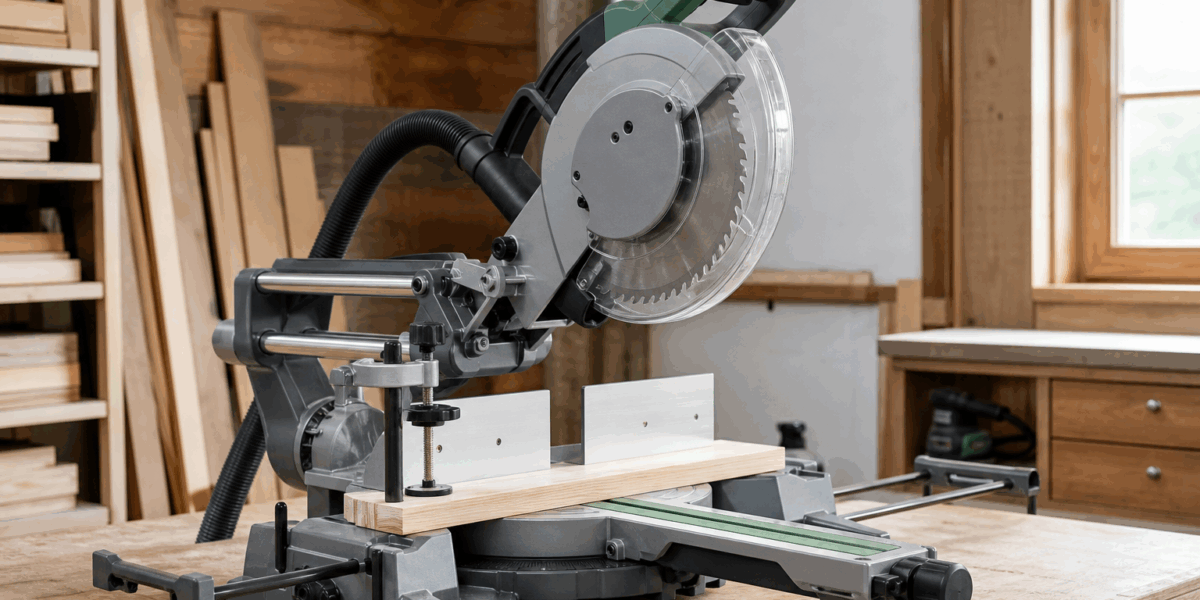
The best sliding compound miter saw depends on the stock you cut, available bench depth, portability needs, dust-control setup, and whether you need a 10-inch or 12-inch blade. For wide framing and trim capacity, the DeWalt DWS780 is a strong general-purpose choice. Bosch’s GCM12SD is compelling where a rail-free glide saves rear space. Makita’s LS1019L offers 10-inch capacity in a reduced-depth design. Festool’s KAPEX KS 120 REB emphasizes a compact footprint, adjustable speed, and system-based dust extraction.
This comparison is based on current manufacturer specifications and manuals, not claimed hands-on testing. Availability, packages, and specifications can change; verify the exact model number before buying.
Best sliding compound miter saws at a glance
| Model | Best fit | Blade | Maximum 90° crosscut documented by maker | Rear-space design |
|---|---|---|---|---|
| DeWalt DWS780 | High-capacity general use | 12 in. | Up to 2×14 dimensional lumber | Traditional sliding rails |
| Bosch GCM12SD | 12-inch capacity near a wall | 12 in. | 3-1/2 x 13-1/2 in. | Axial-Glide arm |
| Makita LS1019L | Compact 10-inch corded saw | 10 in. | 2-13/16 x 12 in. | Forward rail arrangement |
| Festool KAPEX KS 120 REB | Compact system workflow and adjustable speed | 260 mm / 10-1/4 in. | Check the manual’s workpiece table for the cut setup | Forward rail design |
Capacity figures are not perfectly interchangeable: some manufacturers describe nominal dimensional lumber while others publish actual height-by-width dimensions. Compare the maker’s capacity table for the exact miter and bevel angle you will use.
1. DeWalt DWS780: best high-capacity all-around choice
The DWS780 is a corded, 12-inch, double-bevel sliding compound miter saw with a 15-amp motor rated at 3,800 no-load RPM. DeWalt documents up to 2×14 dimensional-lumber capacity at a 90-degree crosscut, a 60-degree right and 50-degree left miter range, tall sliding fences, and its XPS cut-line positioning system.
Choose it when 12-inch blade depth, wide trim or framing capacity, and a visible blade-shadow cut line matter more than a shallow bench footprint. Traditional rear rails require clearance behind the saw, so measure the complete operating envelope rather than the base alone.
Before buying a used or older DWS780, check its date code and rear blade-guard assembly against DeWalt’s official miter-saw recall notice. The notice covers specified DWS779, DWS780, and DHS790 saws manufactured during the listed period; model name alone does not determine whether a unit is affected. Current specifications are on the DWS780 product page.
2. Bosch GCM12SD: best 12-inch option for limited rear clearance
Bosch replaces long rear rails with its articulated Axial-Glide mechanism. The current GCM12SD documentation lists a 15-amp motor, 4,000 no-load RPM, 52-degree left and 60-degree right miter capacity, and 47-degree bevel travel in both directions. At zero miter and zero bevel, Bosch lists a maximum cut of 3-1/2 by 13-1/2 inches.
The principal reason to shortlist this saw is space: its glide system can work where rail travel would push a conventional slider too far from a wall. It is still a 65-pound saw according to Bosch, so compact front-to-back operation does not make it a lightweight carry saw. Confirm that the arm motion, controls, fence height, and dust-hose path work with your bench.
See Bosch’s GCM12SD specifications and manual for angle-specific capacities and compatible vacuum adapters.
3. Makita LS1019L: best compact 10-inch corded choice
The LS1019L is a corded 10-inch dual-bevel sliding compound miter saw with a laser. Makita documents a 15-amp direct-drive motor, a two-steel-rail design that can operate flush against a wall, up to a 12-inch crosscut at 90 degrees, 6-5/8-inch nested crown capacity, and 5-1/4-inch vertical base capacity.
It suits a shop that wants wide crosscuts without moving to a 12-inch blade and values controls accessible from the front. Ten-inch blades are generally easier to share with other 10-inch machines, but blade diameter alone does not determine cut quality or capacity. Check arbor size, kerf, tooth geometry, and the manual’s permitted blade specification.
Verify the current package and included accessories on Makita’s official LS1019L page.
4. Festool KAPEX KS 120 REB: best system-oriented compact option
Festool’s KAPEX uses a 260 mm (10-1/4-inch) blade, forward rail design, twin cut-line lasers, adjustable speed, and a 13-amp motor. Its manual lists a 52-pound weight and a no-load speed range of 1,400–3,600 RPM. The adjustable-speed range can be relevant when the approved blade and material call for a lower setting.
This is the model to evaluate when bench depth, detailed angle controls, portability relative to 12-inch shop saws, and integration with a compatible dust extractor are central requirements. Do not assume premium positioning makes it the best value for every shop. Compare its real workpiece capacity and total system cost—including blades, extraction fittings, supports, and stand—with the jobs you perform.
Use Festool’s KAPEX product page and KS 120 REB manual for current limits and intended materials.
How to choose a sliding compound miter saw
Start with the workpiece, not the blade diameter
List the tallest base molding, widest shelf or board, thickest framing stock, and crown profile you routinely cut. Then check the manufacturer’s capacity at the actual miter and bevel angle. A saw’s maximum 90-degree crosscut does not prove it can cut the same stock at 45 degrees.
Measure front-to-back operating depth
Rail-based sliders may need substantial space behind the fence. Forward-rail and articulated-arm designs reduce that requirement, but dust hoses, handles, bevel travel, and stock support still need clearance. Mock up the footprint on the bench before ordering.
Choose 10-inch versus 12-inch deliberately
A 12-inch saw usually offers more vertical and crosscut capacity, but it also tends to be heavier and takes larger blades. A 10-inch slider can cover many furniture, flooring, and trim tasks while using widely available blades. The right choice is the smallest saw whose verified capacity covers your stock with a reasonable margin.
Decide whether corded or cordless solves the real problem
Cordless matters when power access and jobsite movement are recurring constraints. For a stationary shop, a corded model avoids battery-platform and runtime questions. Compare the complete kit: bare-tool listings do not include batteries or chargers, and battery-powered saw capacity can vary with the specified pack.
Evaluate the cut-line system
A shadow system projects the blade’s actual kerf; a laser projects a reference line that may require adjustment. Neither replaces a test cut. The blade’s kerf, tooth set, deflection, stock movement, and calibration still affect the result.
Plan dust collection realistically
Miter saws expose a large moving opening around the blade, making collection difficult. Compare the documented port and adapter sizes, then plan hose routing so it does not interfere with the slide or bevel. Treat manufacturer collection percentages as test-condition claims, not guaranteed performance in your shop.
Check service, parts, and warranty
Confirm the warranty for your country, the nearest authorized service location, and availability of guards, fences, brushes, inserts, clamps, and adjustment parts. A current model with accessible documentation and parts can be a better long-term purchase than a discounted discontinued saw.
Calibration checklist after setup
- Unplug the corded saw or remove the battery before inspection or adjustment.
- Install an approved, undamaged blade in the correct direction and verify the guard operates freely.
- Check the blade against the table and fence using the procedure in the model’s manual.
- Test the zero-degree miter and bevel positions on scrap, then verify common detents.
- Check fences for alignment and clearance through the full miter and bevel range.
- Secure the saw to a stable surface and provide independent support for long stock.
- Connect the specified collection hardware and confirm it cannot contact moving parts.
Never place a hand in the marked no-hands zone, reach behind the fence near the blade, or cut unsupported stock. Read the exact saw manual before use; procedures and clearances differ by model.
A miter saw can be the exception to your primary cordless ecosystem, especially in a stationary shop. Our guide to choosing a woodworking tool brand explains when standardization saves money and when mixing brands produces a better shop.
\n\n
Which model should you buy?
- Choose DeWalt DWS780 for broad 12-inch capacity and an integrated shadow cut line.
- Choose Bosch GCM12SD when you need 12-inch capacity but cannot spare space behind traditional rails.
- Choose Makita LS1019L for a reduced-depth 10-inch corded design with up to a 12-inch 90-degree crosscut.
- Choose Festool KAPEX KS 120 REB when its compact system, controls, adjustable speed, and extraction workflow justify the total cost.
These are shortlist recommendations, not laboratory rankings. If possible, handle the controls, test the intended blade and stock, and verify calibration and dust-extractor compatibility before committing.
Frequently asked questions
What is the difference between a compound and sliding compound miter saw?
A compound saw can rotate for miter cuts and tilt for bevel cuts. A sliding compound saw also moves the blade assembly through the workpiece, increasing crosscut width.
Is a 10-inch or 12-inch sliding miter saw better?
Neither is universally better. A 12-inch model usually provides greater depth or molding capacity; a 10-inch model can be lighter, use less-expensive blades, and still crosscut wide boards when paired with an effective slide design.
Can a miter saw cut metal or plastic?
Only when the saw manual and an approved blade explicitly allow that material. Do not infer permission from motor power or fit an abrasive wheel to a woodworking miter saw unless the manufacturer authorizes it.
Does a more expensive saw arrive perfectly calibrated?
No purchase price guarantees calibration after manufacturing and transport. Inspect and calibrate every saw according to its manual, and recheck after moving it or after an impact.
Specifications reviewed August 2026. Confirm current product documentation, safety notices, and package contents before purchase.




Stay in the loop
Get the latest the home woodshop updates delivered to your inbox.