Why Your Router Bit Is Burning the Wood
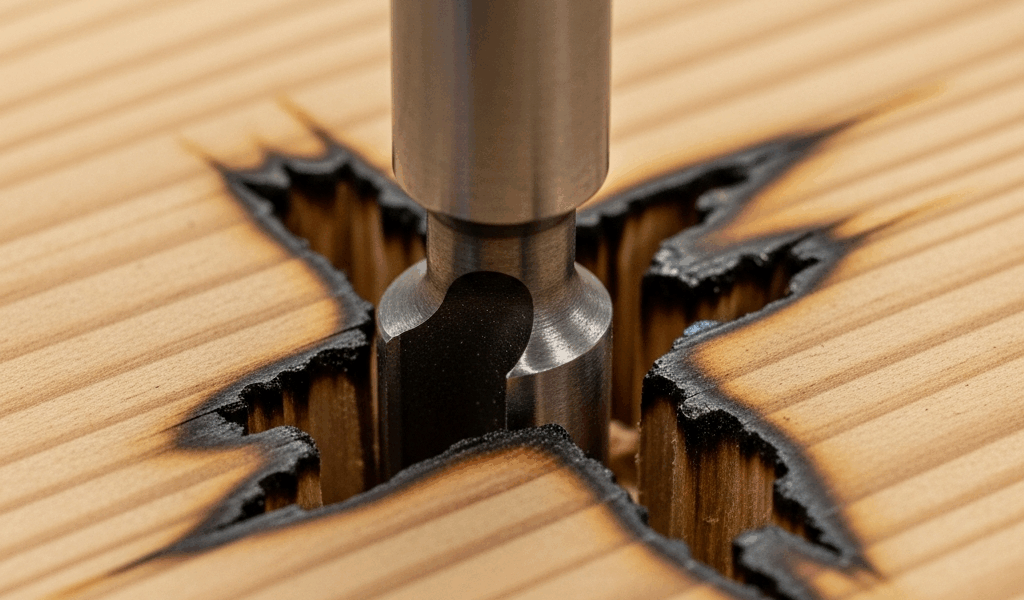
Router bit burning has gotten complicated with all the conflicting advice flying around. Slow down. Speed up. Buy better bits. Use wax. Everyone’s got a theory. Here’s the actual answer: heat. Friction between the cutting edge and the wood generates enough temperature to char the fibers — and that scorched smell plus dark discoloration aren’t just ugly. They’re your router telling you something has gone wrong mechanically.
Three culprits account for nearly every burn mark you’ll ever see. The bit is dull — meaning the edges have rounded over and are rubbing instead of slicing. Your feed rate is too slow — forcing the bit to sit in one spot longer than it should. Or your RPM is set too high for the bit diameter or wood species. Most woodworkers guess which one it is. You’re going to know for sure.
How to Tell If a Dull Bit Is the Problem
A dull router bit doesn’t cut. It abrades. Push a dull edge through wood and you get friction heat instead of clean chips. The giveaway is resin and pitch buildup coating the flutes — dark brown, sometimes nearly black. Look close under a decent work light and you’ll also spot tiny chipped areas on the carbide itself.
There’s a tactile clue too. A sharp bit practically feeds itself. You’re barely pushing. A dull bit? It resists you. You’re white-knuckling the handles. The cut surface looks fuzzy, and burns show up even at the very beginning of a fresh pass — before feed rate could possibly be the problem.
Probably should have opened with this section, honestly. I once burned through three pieces of red oak convinced my RPM setting was off, when in reality my 1/2-inch roundover bit had been hanging in my wall cabinet for two years collecting shop dust. Don’t make my mistake. A quick soak in citrus-based cleaner — Boeshield works, plain mineral spirits works fine too — removes surface pitch and brings a lot of “dead” bits back to life. Five minutes and a wire brush. But if the carbide is actually chipped or the flutes are uniformly rounded over, you’re replacing it. A fresh bit from Freud, Whiteside, or Amana runs $15 to $40 and ends the guessing immediately.
Feed Rate and RPM — Getting the Numbers Right
Bit diameter and RPM have an inverse relationship. Smaller bits spin faster without generating dangerous friction. Larger bits need slower rotation to keep cutting speed manageable. Think about it this way: the tip of a 2-inch bit spinning at 24,000 RPM is traveling at an entirely different speed than a 1/4-inch bit at the same setting — far more friction, far more heat, far more burning.
Here’s a reference worth keeping near your router table. A 1-inch straight bit in hardwood runs cleanly around 18,000 RPM with a steady forward push — roughly speed dial 5 or 6 on a mid-range variable-speed router. A 1/2-inch bit handles 22,000 RPM fine. A 2-inch panel-raising bit wants 12,000 RPM or lower. Softwoods like pine tolerate slightly higher speeds because they shed heat faster and make drier, smaller chips.
Feed rate is how quickly you move the router through the material. Move too slowly and the bit dwells — sitting in one spot generating heat instead of cutting forward. Dwelling is the enemy. On a handheld router cutting a straight hardwood edge, you want a consistent, steady sound from the motor. Not a high-pitched whine — that’s binding. Not a grinding growl — that’s friction winning. A reasonable feed rate on 3/4-inch hard maple with a 1-inch bit is roughly 12 to 18 inches per minute. Not fast. But absolutely not stopped.
Plunge cuts break this rule entirely. Drop straight down into a tabletop to start a dado and your feed rate is zero. Dwell city. Reduce RPM by about 25 percent before you plunge, go slowly, give the chips somewhere to escape. Then push forward once you’ve reached full depth.
Other Causes Worth Checking
- Wrong bit profile for the material. An upcut spiral evacuates chips up and away, cooling the bit faster — better for speed. A downcut spiral leaves a cleaner top surface on plywood but traps heat underneath. Pick upcut for production cutting, downcut for veneered panels where tear-out matters more than temperature.
- Resin and pitch coating the flutes. A dirty bit acts dull even when the carbide is still sharp underneath. Mineral spirits and five minutes of soaking restore cutting performance. A wire brush handles anything stubborn. I’m apparently a chronic bit-neglector and the citrus soak works for me while scrubbing dry never really does.
- Cutting too deep in a single pass. More than 1/4 inch per pass in hardwood forces the bit to work harder than it should. Two shallow passes at 3/16 inch beat one aggressive pass every time — cleaner cut, cooler bit, less drama.
- Climb cutting on every pass. Cutting against the conventional direction can produce a cleaner edge, but it also lets the bit pull itself through faster than you can safely control — causing binding and burns. Reserve climb cutting for final light finishing passes only, and only at the router table where featherboards and a push shoe keep things under control.
How to Fix Burn Marks Already on the Wood
Burned fibers don’t just fade. They char. Depending on depth, you’ve got two paths forward.
Light surface burns — thinner than a business card — respond well to a card scraper. Angle it at roughly 45 degrees, pull it toward you with steady pressure, and the edge curls away char without digging into sound wood beneath. Follow that with 120-grit sanding along the grain. Stain hides the faint shadow that usually remains. Not perfectly, but well enough for most projects.
Deeper burns, especially on end grain where char soaked in, need sanding. Start at 80-grit to remove the black layer, work up through 120, then 150. End grain absorbs stain unevenly after burn damage — a pre-stain conditioner like Minwax Pre-Stain evens out the final color considerably. Burns that go below your finished surface depth? You’re either re-routing that section or accepting the mark as part of the piece’s story. That was the last chair leg I ever tried to rush.
The real fix is upstream. Diagnose whether your bit was dull, your RPM was wrong, or your feed rate stalled — and the next piece comes out clean. That’s the shift from trial-and-error to actually understanding what your router needs from you.



Stay in the loop
Get the latest the home woodshop updates delivered to your inbox.