
Planning a workshop layout has gotten complicated with all the conflicting advice about machine placement, workflow triangles, and space optimization. As someone who has designed and redesigned my own shop layout three times — and helped two friends lay out their new shops — I learned what actually matters versus what sounds good on paper. Today, I will share it all with you.
But what is a workshop layout planner, really? In essence, it’s a systematic process for arranging your tools, workbenches, storage, and workflow paths so the shop functions efficiently and safely. But it’s much more than moving equipment around — a well-planned layout removes friction from your work process in ways that compound over every single project you build.
Start With an Accurate Floor Plan
Measure everything before you place anything. Floor dimensions, obviously — but also ceiling height, door locations and swing directions, window positions, existing electrical panel location, and any fixed obstacles like posts, water heaters, or HVAC equipment.
Mark all of this on graph paper or in a simple CAD tool. A scale of 1/4″ per foot works well for most home shop sizes. Make the floor plan accurate — estimating is how you end up with a planer that’s 6″ too close to the wall to use comfortably.
Inventory Your Equipment With Dimensions
Every major machine needs to go on the plan with its actual footprint plus operating clearances. A table saw’s footprint is small — but add 4 feet of outfeed space and 3 feet of rip clearance on each side and the true space requirement is much larger.
Common operating clearances: table saw needs full sheet outfeed (8’+ behind blade), ripping clearance on both sides, and infeed space in front. Bandsaw needs clearance for long boards coming in from the front. Jointer needs full board length clearance at both infeed and outfeed. Planer needs the same.
Cut out scaled paper templates for each machine (including clearances) and move them around on your floor plan. This physical exercise reveals space conflicts more intuitively than mental math.
Define Your Primary Workflow
Most woodworking shop work follows a sequence: rough lumber comes in → gets jointed and planed → goes to the table saw for ripping → to the miter saw for crosscutting → to the workbench for assembly and fitting. Ideally, material flows in one direction through these stations without crossing back on itself.
In a small shop, a perfect linear workflow is rarely achievable. The goal is to minimize the crossings and backtracking. Placing your jointer and planer near each other and near the table saw makes sense because these tools are used sequentially in the milling process. Placing them on opposite sides of the shop means constant trips back and forth carrying heavy rough lumber.
Storage: Near the Point of Use
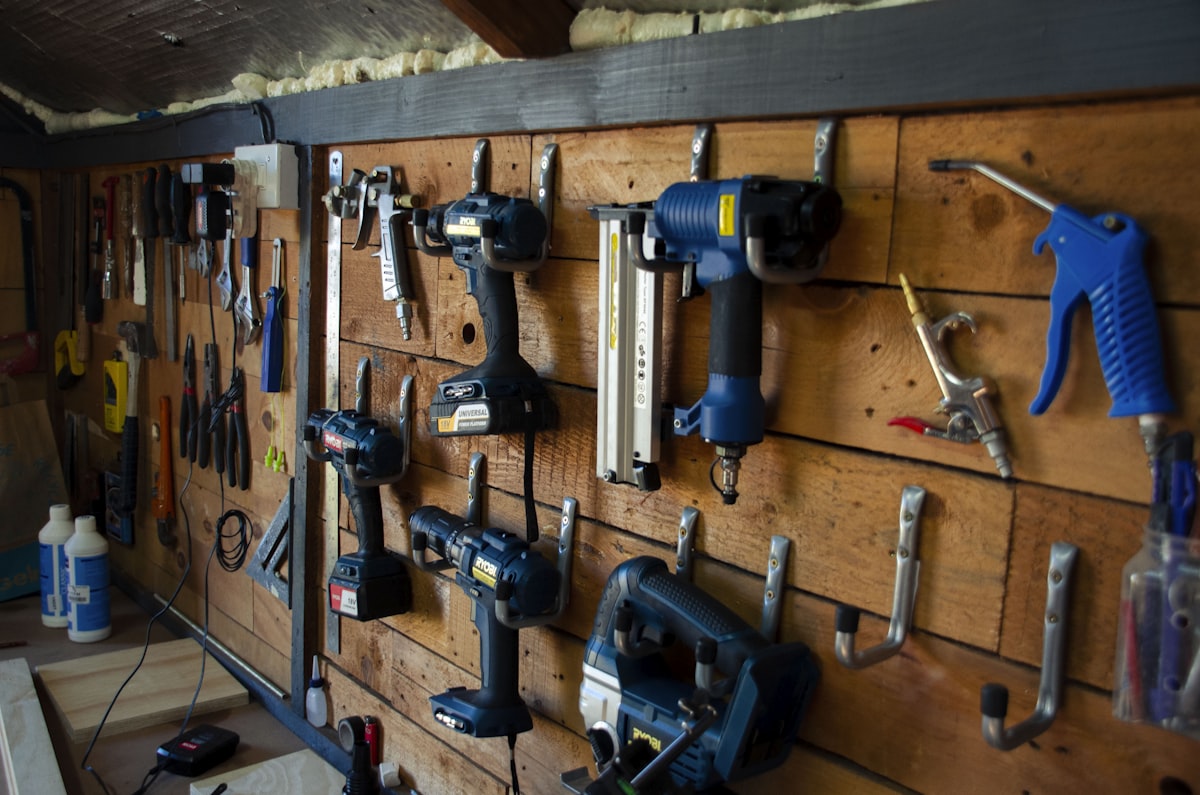
Hand tools should be stored near the workbench where they’re used. Sheet goods storage near the table saw. Rough lumber near the jointer/planer. Finishing supplies near the finishing area.
This sounds obvious but gets violated constantly in real shops. The wall where it’s convenient to hang things isn’t always the wall near the right machine. Force yourself to think about where each category of storage makes functional sense, not just where there happens to be wall space.
Vertical storage for lumber is almost always better than horizontal stacking. A lumber rack that keeps boards on edge or stored vertically uses wall space efficiently, keeps boards straighter, and makes individual boards accessible without moving everything on top.
Power, Lighting, and Dust Collection Infrastructure
These are the boring parts that determine how pleasant the shop is to work in.
Power outlets should be at machine locations — not across the room requiring extension cords. An electrician visit before finalizing layout saves significant frustration. Confirm which machines need 220V circuits and locate those circuits where the machines will actually be.
Lighting needs to be even and bright at every workstation. Shadows cause mistakes. Plan for overhead fluorescent or LED shop lights positioned to eliminate shadows at the bench, the table saw fence, and the miter saw fence.
Dust collection ports need to reach every stationary machine. Either plan for a central system with fixed runs of duct, or ensure your portable dust collector can reach each machine with reasonable hose routing.
Leave Movement Paths Open
The most common mistake in small shop layouts is placing machines too close together. Machines that look fine on paper feel claustrophobic when you’re actually feeding a 10-foot board into them with another machine 18 inches away from your elbow.
Plan for minimum 36″ aisles between any two points you regularly walk between. Wider — 48″ or more — where you’ll be maneuvering long material. If your shop is small enough that this creates impossible constraints, it’s a signal that you have too many machines for the space, not that the aisles can be narrower.
Build in Flexibility
Put heavy machines on mobile bases. Even if you don’t think you’ll rearrange often, the ability to roll a tool out of position occasionally is genuinely useful — for cleaning behind it, for accessing a wall outlet, for reconfiguring for an unusual project.
Don’t build permanent storage in areas where you might want to move a machine later. Shelves on exterior walls are fine; built-in cabinets in the middle of the floor are commitment.



Stay in the loop
Get the latest wildlife research and conservation news delivered to your inbox.