Dust Collection for Small Workshops — What Actually Works
After spending three years moving my woodworking setup between a one-car garage, a basement corner, and finally a converted storage room, I’ve learned more about dust collection for small workshops than I ever wanted to know. Most of what I found online assumed I had a dedicated 2,000-square-foot facility with unlimited budget and floor space. I didn’t. I had twelve feet by fourteen feet, a skeptical spouse, and maybe $400 to spend. That’s when everything changed.
Dust collection in a small workshop isn’t about replicating what commercial shops do. It’s about making intelligent compromises and understanding what actually matters when your workspace is measured in single digits of square footage.
Shop Vac vs Dust Collector — The Real Difference
This is probably where I went wrong first. I bought a shop vac thinking it would solve everything. Five months later, I bought a dust collector anyway. Both purchases were necessary, but I didn’t understand why.
A shop vac pulls hard and fast. High suction, low volume. You hear it working. It screams when you turn it on. That raw suction power excels at detail work—sanding orbital sanders, routers, edge sanders where chips scatter in all directions. The shop vac scoops them up immediately. If you’re doing hand tool cleanup or light machine work, a shop vac is genuinely your first move.
Frustrated by planer chips that overwhelmed my shop vac, I researched dust collectors. A dust collector works differently. It pulls air more gently across a larger volume. Moderate suction, high volume. Your table saw or planer produces chips continuously, and those chips need steady, reliable evacuation rather than brute-force suction. A dust collector handles that rhythm better. It’s the difference between sprinting and jogging.
Here’s the honest truth: in a small workshop, you probably need both eventually. Not immediately. But eventually.
- Shop vac: hand sanders, random orbitals, routers, edge work, general cleanup
- Dust collector: table saw, planer, jointer, consistent chip removal
The mistake I made was thinking one tool would cover everything. It won’t. Your budget might force you to start with one, which is fine. Just know that you’re making a choice about priority, not choosing the “best” solution.
Start With a Shop Vac and Auto-Switch
When I had $150 to spend, this is what I bought, and I’d make the same choice again.
A decent shop vac runs about $80-120. The one I own is a rigid 5-gallon model from Home Depot. Nothing special. Does the job. Then I spent $40 on an automatic tool-start switch—an iVAC brand unit, though several companies make them. The switch plugs into an outlet. Your tool plugs into the switch. When your tool draws power, it signals the switch, which triggers the shop vac automatically.
Why this matters in a small space: you forget to turn the vac off otherwise. My first week without the auto-switch, I ran a shop vac for three hours after finishing a sanding session because I simply forgot it was on. The auto-switch eliminates that waste and the heat it generates in an already-compact space.
Total cost: under $150. This setup works for 80% of small workshop tasks. Honestly, many hobbyists never upgrade past this.
The arrangement is simple. The shop vac sits in one corner. I use a 4-inch hose to connect to whatever tool I’m using that day. I keep about 20 feet of hose coiled above the vac on wall hooks. It takes two minutes to switch from sander to router. In a small space, that flexibility matters more than having a permanent duct system.
When to Upgrade to a Dust Collector
Buying a dust collector feels like admitting failure to the small-space woodworker. It doesn’t have to be.
You need a dust collector when your shop vac can’t keep up with continuous chip production. That means you own a planer, a jointer, or you’re running a table saw for extended periods. A shop vac will clog or overheat under that load. A dust collector won’t.
You also need one if you’re planning to run ductwork to multiple machines simultaneously. A shop vac loses suction rapidly over distance. A dust collector maintains pressure better across longer, more complex runs.
I upgraded because I bought a used planer. First session with that planer, the shop vac clogged within minutes. The hopper filled at a rate I couldn’t manage manually. I spent $160 on a Harbor Freight 2HP dust collector—the budget standard for small shops—and it’s been trouble-free for two years.
Don’t spend more than $200 on your first collector unless you have specific reasons. A basic unit does everything. You’re not running a commercial operation. Efficiency gains from a $600 collector won’t matter in your garage.
Small Workshop Ductwork — Keep It Simple
This is where most small-shop advice goes off the rails into territory that doesn’t apply to your space.
You don’t need a complex ductwork system. You don’t need blast gates at six stations. You need one or two permanent connections and flexibility everywhere else.
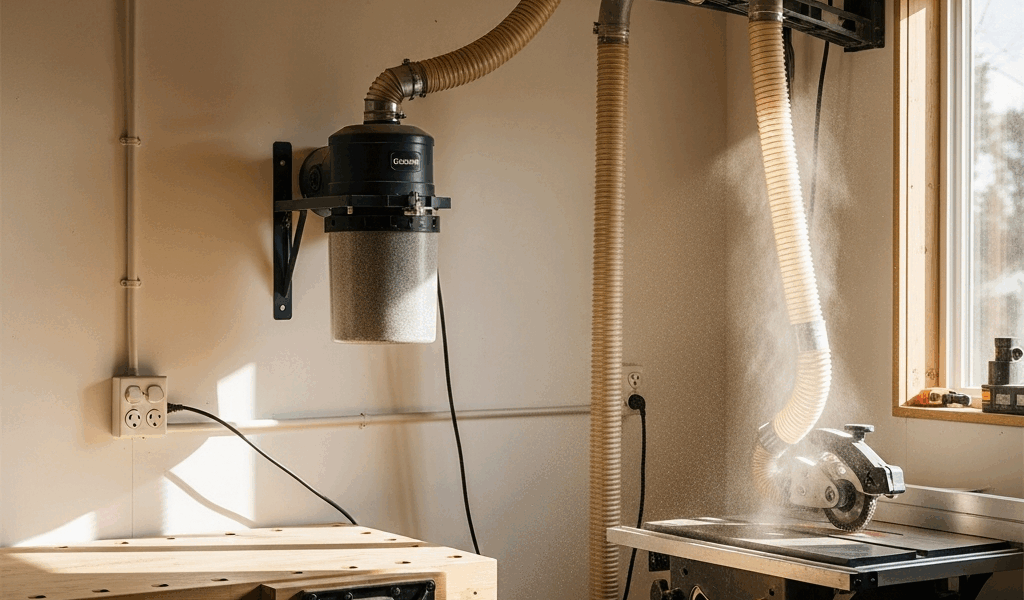
Here’s my setup: the dust collector sits against the back wall, elevated on a platform about two feet high to save floor space. From there, I run a 4-inch flexible hose to my table saw station. That’s permanent. The hose is 8 feet long and taped to the wall with duct tape. At the table saw, I have a blast gate—a simple pivoting flap that lets me open or close that connection without touching the collector.
For everything else, I keep additional 4-inch hose coiled on the wall. My planer connects with a temporary run. Same with the jointer. I could make these permanent if space allowed, but it doesn’t, and honestly, I don’t miss having them that way.
Flexible hose loses suction over distance. This is real, not theoretical. Beyond 15 feet, you’ll notice performance dropping noticeably. Keep runs short. If you need multiple machines fed from one collector, prioritize the machines that run longest or most frequently for permanent connections.
Wall-mounting your collector saves floor space you cannot afford to waste. I mounted mine with four L-brackets bolted directly to the studs. It hangs about three feet off the ground, which also makes emptying the collection bin easier.
Air Filtration — The Piece Most Skip
Probably should have opened with this section, honestly. Dust collection and air filtration aren’t the same thing, and most small-shop owners conflate them dangerously.
A dust collection system catches chips. It doesn’t catch the fine particles that float in the air. Those particles—sawdust that’s become airborne—are the actual respiratory hazard. Dust collection handles the visible stuff. Air filtration handles the dangerous stuff.
I spent two years in my workshop without a dedicated air filter, thinking my dust collection solved the problem. It didn’t. I’d finish a session and still see sunlight streaming through the workshop window, illuminating clouds of floating dust. That dust settles for hours, long after I’ve left.
I bought a WEN 3410 ceiling-mount air filter for $120. It’s a square unit, about 18 inches on each side, that mounts directly to the ceiling. You can plug it into any standard outlet. It pulls ambient air through a HEPA filter and recirculates it.
The filter runs during work and for 30 minutes after I finish. That half-hour afterward clears most of the floating particles. The difference is visible. The air is noticeably clearer.
One caveat: ceiling-mount filters don’t replace proper dust collection. They supplement it. You still need the collection system for chips and bulk debris. The air filter handles the fine particles that escape the collection system no matter what.
Budget $100-150 for a decent ceiling-mounted unit. Don’t cheap out here. A $40 filter from an unknown brand won’t move enough air. The WEN unit moves 400 cubic feet per minute, which is appropriate for a small workshop. That number matters more than brand.
The Real Small-Shop Strategy
After three years and several equipment moves, here’s what I’d recommend if you’re starting from zero in a small space:
Month one: buy a shop vac and an auto-switch. Spend $150. This covers everything except high-volume chip removal.
Month three or four: buy a ceiling-mount air filter. Spend $120. This solves the floating dust problem that dust collection misses.
Month six to twelve: assess whether you need a dust collector. If you own a planer or jointer, or if you’re planning to expand your machine collection, buy the Harbor Freight 2HP unit for $160. If you don’t, stick with the shop vac.
That timeline respects both budget and the learning curve. You’ll understand your actual needs before spending money on upgrades that might not apply to your work.
The small workshop isn’t a compromise on proper dust collection. It’s a different approach. You’re optimizing for space and budget rather than throughput and convenience. Both are valid. Once you accept that, the decisions become obvious.



Stay in the loop
Get the latest the home woodshop updates delivered to your inbox.