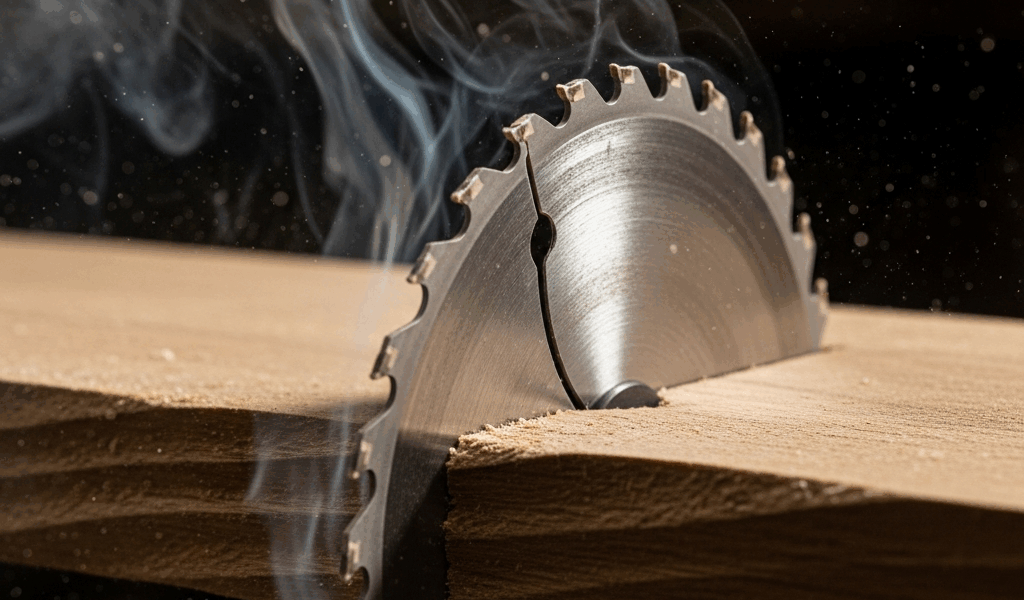
Why a Circular Saw Blade Binds in the First Place
Circular saw binding has become harder to navigate with all the conflicting advice flying around. Everyone’s blaming the saw, the wood, the humidity. But honestly? It almost always comes down to three things — and fixing it means knowing which one you’re actually dealing with.
The blade is sitting too deep in the material, grinding against the kerf walls. The workpiece is sagging or shifting mid-cut, pinching the blade from both sides. Or the blade itself is dull, caked in pitch, or just wrong for the job. That’s it. One of those three is always the culprit.
Set Your Blade Depth the Right Way
As someone who spent two years running a framing crew before eventually crossing over into finish work, I worked through the fundamentals of blade depth the hard way. Today, I will share it all with you.
The rule is simple: expose no more than 1/4 inch of blade below the bottom of the material. Not 1/2 inch. Not a full tooth. A quarter inch. That’s it.
The piece that matters most here. Most people set blade depth once, somewhere around “looks about right,” and never touch it again. Don’t do what I did.
On a standard saw — a DeWalt DCS391L, for example, or anything similar in that compact class — there’s a small lever near the motor housing that slides the shoe up and down. Loosen it, grab a ruler or a caliper, and measure from the teeth to the shoe. Set that gap to exactly 1/4 inch. Tighten back down. For bevel cuts, tip the blade to your angle first, then measure the 1/4-inch gap at the deepest point of the teeth. Same principle, different geometry.
More blade depth means more steel dragging through the kerf. More steel means more side friction. More friction means the motor strains, the blade heats up, and suddenly your saw is fighting the wood instead of cutting it. That’s where kickback starts. A properly set depth cuts faster, runs cleaner, and doesn’t bind. It’s genuinely that straightforward.
How to Support the Wood So It Does Not Pinch
Wood moves. It warps, bows, and redistributes its weight the second you start cutting into it. Without proper support, gravity and kerf pressure will pinch that blade — every single time.
Sheet goods are where I see this go wrong most often. Plywood, MDF, OSB. People lay a full 4×8 sheet flat across two sawhorses and cut lengthwise. The sheet sags in the middle. As the blade reaches that unsupported span, the kerf closes behind it and clamps down hard. I’ve watched guys curse their saw for ten minutes when the real problem was sawhorses spaced four feet apart with nothing underneath.
The fix: supports within 12 inches of the cut line on both sides. Better yet, use three — one on each side of the kerf and one behind the blade to prevent trailing sag. For a standard 4-foot-wide sheet, run that third support directly under the blade path. Kerf stays open. Blade moves freely. No drama.
Long boards are a different problem. Anything over six feet, a bowed 2×10 especially, will want to close the kerf as the blade works toward the high side. You need outfeed support — something at the same height as your saw deck so the board doesn’t drop and pinch as it exits. A bench works. A folding table works. Doesn’t need to be fancy.
Here’s a budget hack I’ve used for years, though. Grab a sheet of rigid foam insulation board — the pink or blue stuff from the home center, usually around $28 for a 4×8 — and lay it on the shop floor under your cut line. The blade cuts partway into the foam, the wood stays supported underneath the whole time, and you skip the outfeed setup entirely. Not pretty. Absolutely works.
When the Blade Itself Is the Problem
But what is a dull blade, really? In essence, it’s a blade that creates friction instead of cutting. But it’s much more than that — a dull or pitch-clogged blade heats up fast, strains the motor, and causes the wood to grip and pinch in ways that feel exactly like a support problem or a depth problem. It mimics everything else.
Check the teeth under bright light. Tips rounded instead of sharp? Burned or discolored along the edges? That’s dull. Dark crusty buildup packed into the gullets? That’s pitch and resin — and it acts like a brake pad on every single tooth.
Pitch buildup is a quick fix. Soak the blade in oven cleaner or a dedicated blade cleaner for 15 to 20 minutes, then scrub with an old toothbrush. A bottle of Krud Kutter runs about $8 and lasts through dozens of cleanings. Rinse thoroughly, let it dry completely, reinstall. I’m apparently sensitive to how my blades perform, and a freshly cleaned blade works for me in ways a gunked-up one never does. The difference is genuinely noticeable from the first cut.
That said — cleaning won’t resurrect actually dull teeth. Rounded tips mean it’s time to replace the blade. A 40-tooth combination blade from Freud or Diablo runs about $25 and handles most general cutting without complaint. A 24-tooth ripping blade cuts faster through framing lumber but leaves a rougher edge. That’s what makes matching tooth count to the job so endearing to us woodworkers — the right blade just disappears into the cut.
Ripping rough framing lumber? Go 24-tooth. Cross-cutting plywood or doing trim work? 40-tooth. Wrong tooth count creates binding just as reliably as dull teeth. Swapping a blade takes maybe 30 seconds with the dedicated wrench that ships with most saws.
Quick Checklist Before Every Rip Cut
- Blade depth set to 1/4 inch below the material — measure it with a ruler, don’t eyeball it.
- Wood supported within 12 inches of the cut line on both sides, nothing blocking the blade path underneath.
- Blade clean and sharp — spin it by hand, look for burn marks or rounded teeth, scrub off pitch if needed.
- Tooth count matches the job: 24-tooth for rips, 40-tooth for cross-cuts and trim work.
- Motor sounds normal and blade spins freely before the cut starts.
So, without further ado — run through those five points before every rip cut. Not most cuts. Every cut. The phantom problems stop. The binding stops. And you stop blaming a perfectly good saw for something that took 90 seconds to prevent.



Stay in the loop
Get the latest the home woodshop updates delivered to your inbox.