Wood Glue Not Holding — Why It Fails and How to Fix It
Wood glue failures have started getting harder to follow with all the bad advice flying around. As someone who’s rebuilt failed joints at midnight with a deadline the next morning, I sat down and learned why glue bonds give up. Today, I will share it all with you.
Most woodworkers point fingers at the clamps. Or the brand. Six hours into an assembly and a joint pops under hand pressure — I’ve been there. Twice in the same week, actually. That’s what finally pushed me to stop blaming equipment and start asking harder questions about surface chemistry, wood species, and temperature. Once you know what you’re actually looking at, failed joints stop being mysterious.
How to Tell If Your Glue Joint Actually Failed
Quick note before the rest of this. Here’s the thing: a good glue joint doesn’t fail at the glue line. It fails through the wood.
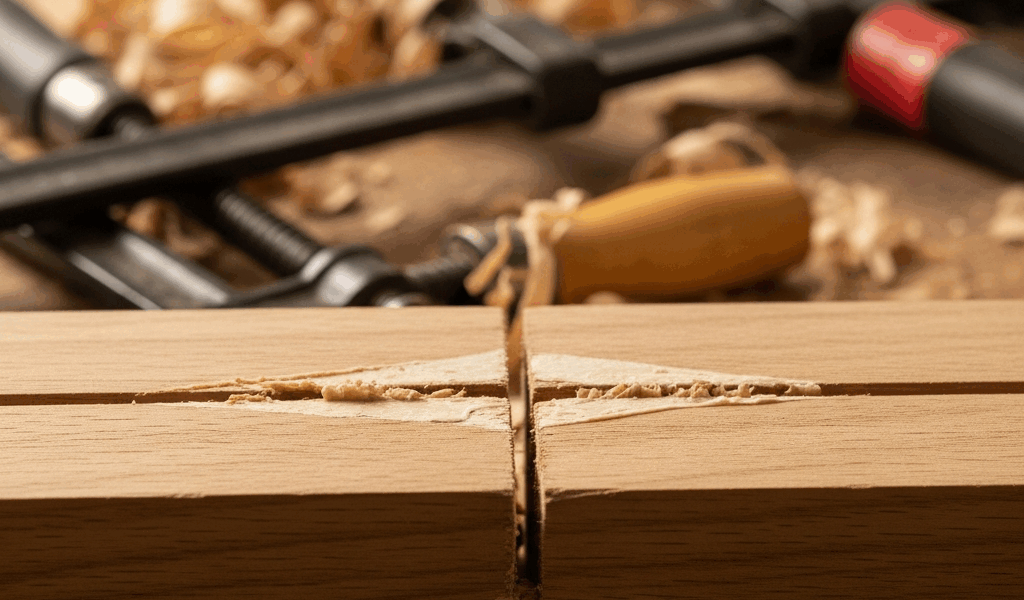
Crack open a joint and look at the break. Wood fiber tearing away from the glue — that’s a successful bond. The wood gave up before the adhesive did. That’s the goal. A joint that separates cleanly at the glue line — thin brown film on one half, bare wood on the other — that’s an actual failure worth diagnosing.
Test this right now if you have a busted joint on your bench. Split it open under a bright light. Does the wood splinter, or does the glue peel cleanly? Fibers stuck to the glue on one face while the other shows bare wood and residue — your joint starved. Glue peeling away like a film from both surfaces — bonding problem. That’s your starting point.
If the original adhesive was mismatched, compare the strengths and limitations of PVA, epoxy, polyurethane, hide, and CA glue in our strongest wood glue guide before rebuilding the joint.
Wrong Glue for the Wood or Job
But what is PVA glue, really? In essence, it’s that yellow bottle most of us grab without thinking. But it’s much more than that — it’s also a product with real limits that will absolutely wreck your project if you ignore them.
PVA works beautifully on pine, birch, poplar. It’s terrible for oily hardwoods. Teak, rosewood, padauk — these contain natural oils that block PVA from soaking into the fiber. The glue sits on top instead of forming a mechanical bond. You can clamp until your hands cramp. Doesn’t matter. Frustrated by teak drawer fronts failing after three months of normal use, I finally switched to epoxy on a batch of eight fronts. The difference was immediate.
Polyurethane glue — Gorilla Glue is the one most people recognize — works through a moisture-based reaction rather than simple evaporation. It expands slightly as it cures. Dense, oily woods respond well to it. Outdoor projects too, where PVA will soften and fail after a wet season. The tradeoffs: 24-hour clamp time instead of 30 minutes, and a purple-brown glue line that shows if your fit isn’t tight.
Epoxy needs mixing, has a pot life around 15 minutes depending on the formulation, and simply doesn’t care about wood species or weather exposure. Overkill for pine-to-pine joints. Ideal when you’re working with dense hardwoods or anything that lives outside. That’s what makes epoxy endearing to us woodworkers dealing with problem species.
Match glue to wood type first. Brand loyalty is fine. Chemistry matters more.
Surface Prep Mistakes That Kill Glue Bonds
Mill glaze is the enemy nobody talks about. Running wood through a planer or jointer compresses the fibers and burnishes the surface. Shiny, smooth, looks ready. It’s actually sealed against glue penetration — and that distinction matters enormously.
A freshly jointed face should be glued within a few hours. After that, oxidation sets in and the glaze becomes even more resistant. I learned this the hard way — planed a panel on a Tuesday afternoon, glued it up Wednesday morning. Every joint failed at the glue line. Couldn’t figure it out until I looked at the wood under a 10x loupe and saw how polished the surface actually was. Don’t repeat what I did.
The fix is 120-grit sandpaper for two minutes. Not reshaping — just scuffing enough to break the glaze. Skip this and you’ve already lost the joint before the clamps go on.
Silicone contamination is quieter but equally destructive. I’m apparently sensitive to this one — I use a silicone-based hand cream in winter and it works for my skin while literally nothing else does, but it contaminated three consecutive box joint assemblies before I connected the dots. Any silicone contact — sandpaper stearate, mold release, hand cream on your palms — and PVA won’t bond. Wash hands with dish soap before glue-up. Check your abrasives. Use non-silicone stearate if you’re sanding between sessions.
One more trap: 220-grit or finer can close the grain on softwoods entirely. You want a surface that’s clean and slightly open — not polished. Sand to 120 or 150 for glue joints. Save the fine grits for after the glue cures.
Clamping Pressure and Open Time Problems
More clamps is not the answer. Starved joints — where clamping pressure squeezes out all the glue before it can set — are a real failure mode. Way more common than people admit.
PVA needs enough pressure to bring surfaces into contact and hold them still. Visible squeeze-out along the joint line is what you’re after, but not so much that you’re crushing fibers. Excessive pressure forces glue out faster than it can cure. Dry joint. Failed project.
Open time swings dramatically with temperature. At 70°F, standard Titebond Original has roughly 15 minutes. At 50°F, you get close to 30. In a cold January shop, glue skins over before parts are even positioned. I used to glue up in an unheated garage in December — shop was sitting at 45°F — and genuinely couldn’t understand why everything was failing. The glue was skinning in five minutes. That was 2019. I know better now.
Cold shop: use slow-set PVA or warm the bottle in a water bath to around 70°F before you open it. Bring wood to room temperature too. Dry air accelerates set — humid air slows it. Your actual workable window might be much shorter than the label suggests.
How to Fix a Failed Joint Without Ruining the Piece
While you won’t need to rebuild the entire piece, you will need a handful of basic tools and some patience. So, without further ado, let’s dive in.
Step one: Split the joint open. A chisel and light hammer taps, working gradually into the glue line. Solid wood panels tolerate some damage here. Delicate mortise-and-tenon joints — work slower. Much slower.
Step two: Clean dried glue from both faces. Card scraper or 120-grit sandpaper, working across the grain — never against it. Remove enough glue that bare wood is visible across the whole surface. A sharp chisel handles stubborn chunks, though gouging is a real risk if you rush.
Step three: Inspect both surfaces. Look for mill glaze or contamination. Light 120-grit scuffing if needed. Wipe with a clean damp cloth — not soaked, damp — and let dry completely. Thirty minutes minimum in normal humidity.
Step four: Re-glue with attention to what actually failed. Glue skinned over — warm the shop or the bottle. Joint starved — ease off clamp pressure. Oily wood — switch to West System epoxy or Gorilla Polyurethane. This new approach takes maybe ten extra minutes of prep and eventually evolves into the reliable process experienced woodworkers know and trust.
Before committing to re-glue, ask whether the joint is structural. A failed breadboard end — reglue it. A failed mortise on a chair leg that holds a person’s weight — that’s a rebuilding job, not a repair.
Quick checklist for re-glue:
- Surfaces clean and glaze-free
- Shop temperature 65°F or warmer
- Correct glue selected for wood type
- Clamps staged and positioned before glue touches wood
- Open time confirmed for current temperature
- Moderate clamp pressure — squeeze-out visible but not excessive
- 24-hour cure before any stress on the joint
The joint will hold this time. Not because you clamped harder — because you actually diagnosed what went wrong.

Stay in the loop
Get the latest the home woodshop updates delivered to your inbox.