Building a tool collection for a woodworking shop has gotten complicated with thousands of options at every price point and conflicting advice about what you actually need versus what manufacturers want you to buy. As someone who has started two shops from scratch and learned which tools earn their place and which collect dust, I know the essential tools that every woodworker actually needs. Today, I will share it all with you.
But what makes a tool “essential”? In essence, it’s a tool that enables work you can’t do without it — not a convenience, not a nice-to-have, but a genuine capability requirement. But it’s much more than just a list of tools — the most essential tools are the ones that unlock everything else in your process.

The Cutting Foundation
Every woodworking shop revolves around cutting — breaking down rough material to workable size, then making precise cuts for joinery and parts. The essential cutting tools depend on your approach, but for most shops:
A table saw is the most versatile and central tool in the majority of woodworking shops. Ripping boards to width, crosscutting with a sled, making dadoes and rabbets, cutting tapers — the table saw does all of these. The learning curve for safe operation is real and worth taking seriously, but no other single tool provides the same range of essential operations.
A miter saw handles repetitive crosscutting more conveniently than a table saw — precise, fast, and easy to set up for common angles. For cutting parts to length and cutting angles for trim or frame components, a miter saw earns its floor space.
A jigsaw handles curves and shapes that straight-cutting machines can’t reach. Not every project needs a jigsaw, but for templates, patterns, and curved parts, it fills a gap that nothing else addresses as well at its price point.
Material Preparation
Working from rough lumber — which is how most furniture-grade wood is sold — requires surfacing and dimensioning tools. The essential pair: a jointer for flattening one face and squaring one edge, followed by a thickness planer to bring the board to consistent thickness parallel to the jointed face.
Without these two tools, you’re working from pre-dimensioned S4S lumber, which limits your material options and costs more per board foot. With them, you can buy rough lumber from hardwood dealers, get dramatically better selection, and dimension it yourself.
Drilling
A drill/driver — cordless, 18V or 20V — is one of the most used tools in any shop. Assembly, hardware installation, pilot holes, pocket holes — the cordless drill is present at nearly every stage of construction. A quality cordless drill from a major brand (DeWalt, Makita, Milwaukee) is worth the investment; budget drills struggle with the sustained use patterns of woodworking.
A drill press adds perpendicular drilling accuracy that a handheld drill can’t match. For doweling, hinge mortises, and any operation where hole angle is critical, the drill press pays for itself in accuracy.
Smoothing and Shaping
Hand planes earn their place even in a machine-heavy shop. A good bench plane — a #4 or #5 — trims joints to perfect fit, flattens small surfaces, and does fine fitting work that would be awkward and dangerous to set up a machine for. The learning curve on sharpening and using a hand plane is moderate, and the payoff in capability and control is significant.
For power smoothing, an orbital random-orbit sander produces a finish-ready surface faster than hand sanding. The random-orbit pattern minimizes visible scratch patterns that orbital and belt sanders leave.
Joinery
Sharp chisels are the joinery workhorse. Fitting mortises, cleaning up saw cuts, trimming hinge mortises, paring joints to fit — chisels do this work. A basic set of four (1/4″, 1/2″, 3/4″, 1″) in a quality brand covers most tasks. Buy fewer better chisels rather than more cheap ones.
Measuring and Layout
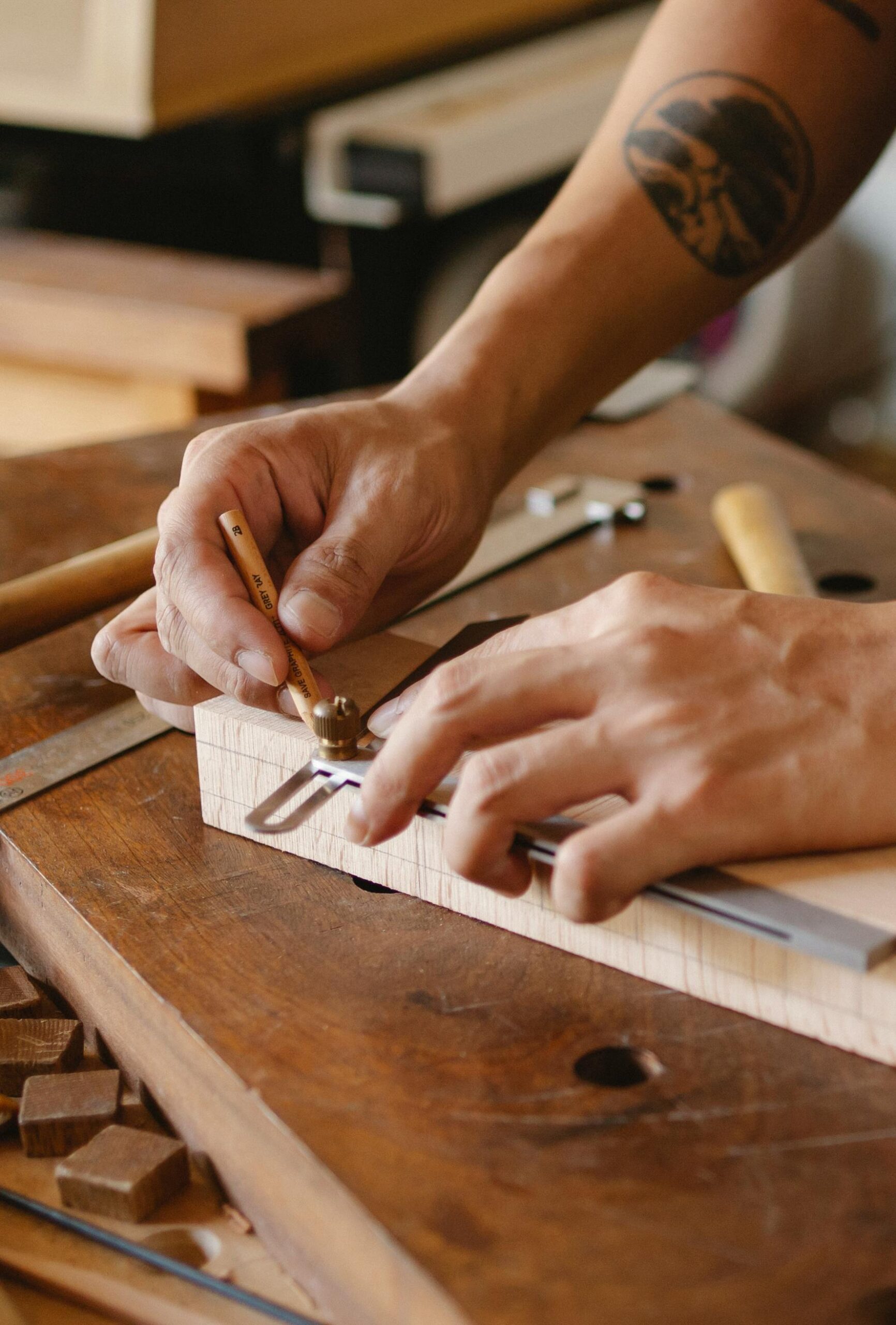
Accurate layout is where precise work starts. A combination square — verified square and used daily — is the single most-used measuring tool in my shop. A marking gauge for scribing parallel lines. A tape measure for larger measurements. A marking knife for precision layout lines that a pencil can’t provide at woodworking tolerances.
Safety
Safety glasses at every machine — not reading glasses, not regular prescription glasses, actual safety-rated eyewear. Hearing protection rated for woodworking noise levels. A dust mask or respirator appropriate for the work being done. These are not optional, and the habit of using them needs to be automatic.
Recommended Woodworking Tools
HURRICANE 4-Piece Wood Chisel Set – $13.99
CR-V steel beveled edge blades for precision carving.
GREBSTK 4-Piece Wood Chisel Set – $13.98
Sharp bevel edge bench chisels for woodworking.
As an Amazon Associate, we earn from qualifying purchases.



Stay in the loop
Get the latest wildlife research and conservation news delivered to your inbox.