Jointer vs Planer — Which One Should You Buy First
The jointer vs planer debate has gotten complicated with all the conflicting advice flying around woodworking forums. As someone who bought the wrong machine first and spent four months staring at a useless benchtop jointer in the corner of my garage, I learned everything there is to know about this particular mistake. Today, I will share it all with you.
This article includes affiliate links. We may earn a commission at no extra cost to you.
That jointer was a 6-inch model — cost me around $600. Sat there collecting sawdust while I had no way to finish milling the rough walnut boards I’d pulled from a local sawyer. Don’t make my mistake.
The Real Difference Between These Two Machines
But what is a jointer, really? In essence, it’s a machine that creates a reference surface. But it’s much more than that — it’s the first half of a two-step process most beginners don’t realize they’re signing up for.
You run a board over rotating knives set flush with an outfeed table. One flat face. One square edge. That’s your reference point — nothing more. The planer then takes that flat face, registers it against a flat bed, and cuts the opposite face parallel to it. Flat, square, consistent thickness. Together they’re a complete system. Separately, each one is genuinely half the equation.
That relationship is the whole ballgame. Everything else here hangs on it.
Why Most Beginners Buy the Wrong One First
Probably should have opened with this section, honestly. Before you spend anything, answer one question: what kind of lumber are you actually buying right now?
Walk into a Home Depot and grab a 2×6 off the rack. That board has already been surfaced on four sides — S4S lumber, the industry calls it. Not perfectly flat, but close enough. Dimensionally consistent. For boxes, shelves, simple furniture — you can run with S4S and never touch either machine.
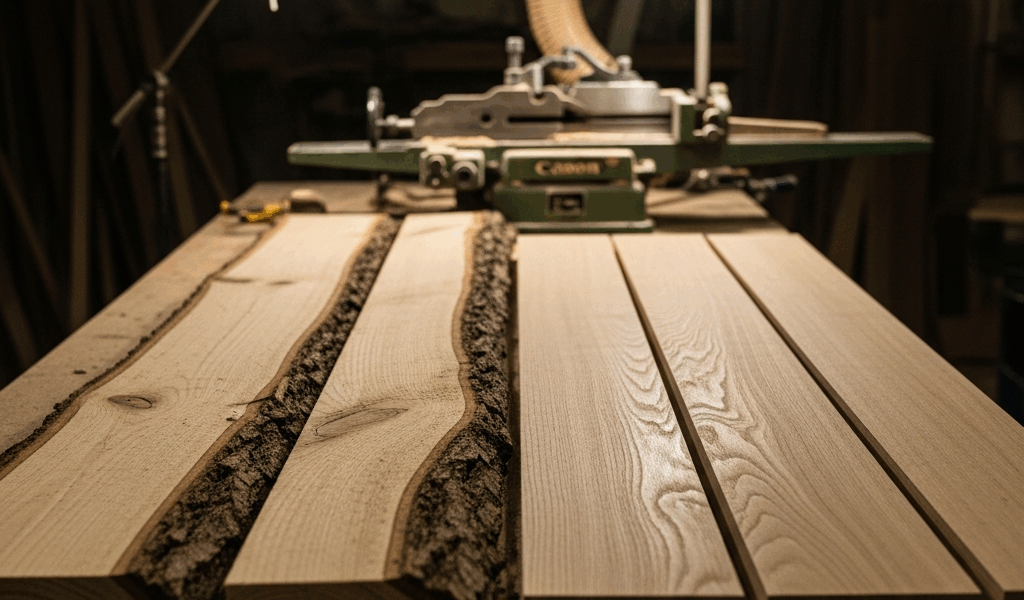
Now go find a local hardwood dealer and buy rough-sawn cherry. Different world entirely. Cupped, bowed, twisted, rough on both faces. Raw material, not a finished product. Milling it flat and square requires both machines — not one, both.
Here’s the trap a lot of people fall into. They read that a jointer is the first step in milling rough lumber — which is true — and they buy one. Then they run a face and an edge and just… stop. Because there’s nowhere to go. A jointer cannot thickness a board. That’s not what it does. A jointer without a planer is like owning half a car. It looks right sitting in your shop. It doesn’t take you anywhere useful.
Buying a jointer first while you’re still sourcing lumber from the big box store is spending money on a problem you don’t have yet.
Jointer First — When It Actually Makes Sense
If you’re already buying rough lumber regularly — actual hardwood from a mill or dealer — and you care about dead-flat glue-up surfaces, then yes, start with the jointer. Twisted or cupped boards that go through a planer without jointing first just come out consistently twisted and cupped. The jointer is the gatekeeper. That’s what makes it essential to serious furniture builders.
For furniture work, a 6-inch benchtop model like the JET JJ-6HHDX runs around $600–$700 and handles most boards you’ll encounter — until it doesn’t. Anything over 5 inches of actual width starts overhanging the tables. An 8-inch floor model like the Grizzly G0490 changes things significantly. Wider stock, wider panels, real versatility on furniture-grade material. Price jumps to $1,000–$1,200, but the capability jump is genuine.
Budget tight? A quality hand plane — a #7 jointer plane or a Veritas low-angle jack at around $200–$350 — can flatten boards by hand. Slower, sure. Builds real skill, though. Takes up almost no space. Many serious woodworkers flatten slabs entirely by hand and match machine results. Not a joke option at all.
But jointer first only makes sense if you immediately pair it with a planer. Otherwise you’re stopping the milling process exactly halfway through.
Planer First — When It Makes More Sense
This is the stronger case for most beginners. Full stop.
Frustrated by inconsistent board thickness from the home center and wanting to actually build things, a beginner furniture maker will get more usable work done per dollar from a benchtop planer than almost anything else they could put in their shop. The DeWalt DW735 — typically $550–$600 new, often $300–$400 used — is the benchmark. Two-speed feed, 13-inch capacity, genuinely solid build. It’s the machine I wish I’d bought first.
Here’s what a planer actually unlocks for someone early in the process:
- Thickness S4S lumber down to exactly what a project requires — 3/4 inch, 1/2 inch, whatever custom dimension you’re after
- Clean up resawn boards after running them through a bandsaw
- Mill construction lumber — 2x4s, 2x6s from the hardware store — into smooth, usable stock for a fraction of hardwood prices
- Flatten wide slabs with a router sled jig first, then run them through the planer to clean up the surface
That last point matters more than it sounds. A router sled — a flat frame holding a router above a slab — lets you surface material wider than the DW735’s 13-inch capacity. It’s a workaround, not a replacement for a jointer. But it handles slabs and wide panels when you’re not ready to spend $600–$1,000 on another machine yet.
The observable progress is also real and it matters early on. You feed a rough, dull-looking board into one side. A smooth, clean board comes out the other. That feedback loop keeps you building projects instead of theorizing about workflow — and that’s worth something when you’re still figuring out what kind of woodworker you want to be.
The Bottom Line — One Clear Recommendation
Buy the planer first.
I’m apparently a “buy the wrong tool first and learn from it” type of person, and the DeWalt DW735 works for me now while that early jointer never really did — at least not at that stage of my shop. If your budget is under $600 and you’re sourcing any lumber from a big box store or buying S4S hardwood from a dealer, a benchtop planer will do more visible, useful work earlier in your woodworking journey than a jointer will. It solves problems you already have.
Add the jointer second — once you’re buying rough lumber regularly and you know exactly why you need one. At that point you’ll have enough context to choose the right size — 6-inch benchtop or 8-inch floor model — without guessing.
Short on space and want to skip the sequencing problem entirely? The Jet JJP-10BTOS is a combination jointer-planer running both operations in one footprint for around $1,600–$1,800. Not cheap. But if you’re serious and square footage is genuinely the constraint, it’s worth the conversation.
The goal isn’t to own the most machines — it’s to own the right machine for where your shop actually is right now. Once you’re buying rough lumber by the board foot and working with real hardwoods regularly, you’ll know exactly when it’s time to add that jointer. And you’ll buy the right one, for the right reasons, without a single month of it sitting unused in the corner.

Stay in the loop
Get the latest the home woodshop updates delivered to your inbox.