The Stickley Museum at Craftsman Farms has gotten less attention than it deserves among woodworkers who care about the history of American furniture making. As someone who visited specifically to understand what Stickley’s work actually looks like in person — not in photographs — I came away with a much richer appreciation for the Arts and Crafts movement and why it still influences contemporary furniture design. Today, I will share what I learned.
But what makes the Stickley Museum worth a visit for a woodworker specifically? In essence, it’s the opportunity to see the construction quality and design philosophy of Gustav Stickley’s furniture up close — the joinery, the wood selection, the proportions — in context of the house and landscape he created as a unified expression of those same values. But it’s much more than a furniture exhibition — it’s a living argument for a particular way of thinking about what makes a made object good.
Who Gustav Stickley Was
Stickley was born in 1858 and came to furniture making through practical carpentry in his family’s business. He wasn’t a formally trained designer — he was a craftsman who developed a design philosophy through making things and thinking carefully about what made objects worth making.
His founding of Craftsman Workshops in Eastwood, New York in 1898 marked the beginning of what would become the defining American voice in the Arts and Crafts movement. The furniture that came out of those workshops — Mission style, as it became known colloquially — was characterized by exposed construction (through-tenons with visible wedges, visible joinery rather than hidden fasteners), quartersawn white oak that showcased pronounced ray fleck, and proportions that emphasized horizontal mass and structural honesty.
His magazine, The Craftsman (1901-1916), spread both the furniture and the larger philosophy — that objects for everyday use should be made honestly, from good materials, to be beautiful and durable rather than fashionable and disposable. That argument feels familiar in 2026 in a way it might not have felt in 1920.
What You See at Craftsman Farms
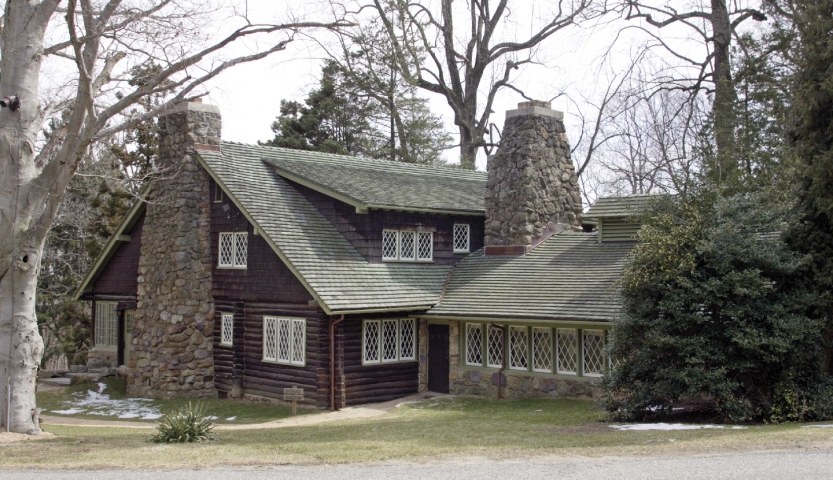
The museum is located at Craftsman Farms, the property in Morris Plains, New Jersey that Stickley intended as a farm school embodying his ideals of honest work and healthy living. Financial difficulties ended that vision, but the property survived as his personal residence and now as a National Historic Landmark.
The Log House — Stickley’s primary residence — is the heart of the museum. Walking through it, you see the furniture in the context it was designed for: specific rooms, specific scales, specific relationships between pieces. A Morris chair that might seem heavy in a white gallery room looks right in a craftsman interior with low ceilings, warm wood surfaces, and natural light from windows framed in quartersawn oak trim.
The construction quality visible up close is worth traveling for. Through-tenons with visible keyed wedges that still fit tight after a century. Quartersawn oak surfaces with the medullary ray figure that Stickley specified because he understood how this cut of wood moves and because he found the pattern beautiful. Hardware in hammered copper and wrought iron that looks hand-made because it is.
Why Arts and Crafts Still Matters to Woodworkers
The Arts and Crafts movement arose as a direct reaction against industrial mass production. The central argument — that machine production degrades both the object and the maker, and that handcraft produces objects with a quality that machines can’t replicate — is an argument woodworkers have a professional stake in understanding.
It’s not that the movement was anti-machine in any absolute sense. Stickley used machine tools extensively. The argument was about what drove design and production: honest material and craft values versus fashion and cost reduction. The design follows from the material and the making, not from marketing trends.
That philosophy is one that any furniture maker who cares about their work recognizes. You see it in contemporary studio furniture makers who design around the specific figure of a board, who leave joinery visible because the joint is honestly made and beautiful to show, who build to last rather than to a price point.
Practical Visit Information
Craftsman Farms offers guided tours that walk through the history, the architecture, and the furniture collection. The knowledgeable docents can engage at a technical level about the construction and design if you ask the right questions — come prepared to ask about specific joints, specific wood species, and the design decisions behind pieces that interest you.
The museum hosts workshops and events that connect the historical craft tradition to contemporary practice. Check the schedule before visiting to see if there’s programming worth timing your visit around.
For a woodworker who hasn’t made this visit, it belongs on the list. The Stickley legacy is part of American furniture making history that has more to say to contemporary craft than most of us realize until we see it in person.



Stay in the loop
Get the latest wildlife research and conservation news delivered to your inbox.