The Two Saws Woodworkers Actually Debate
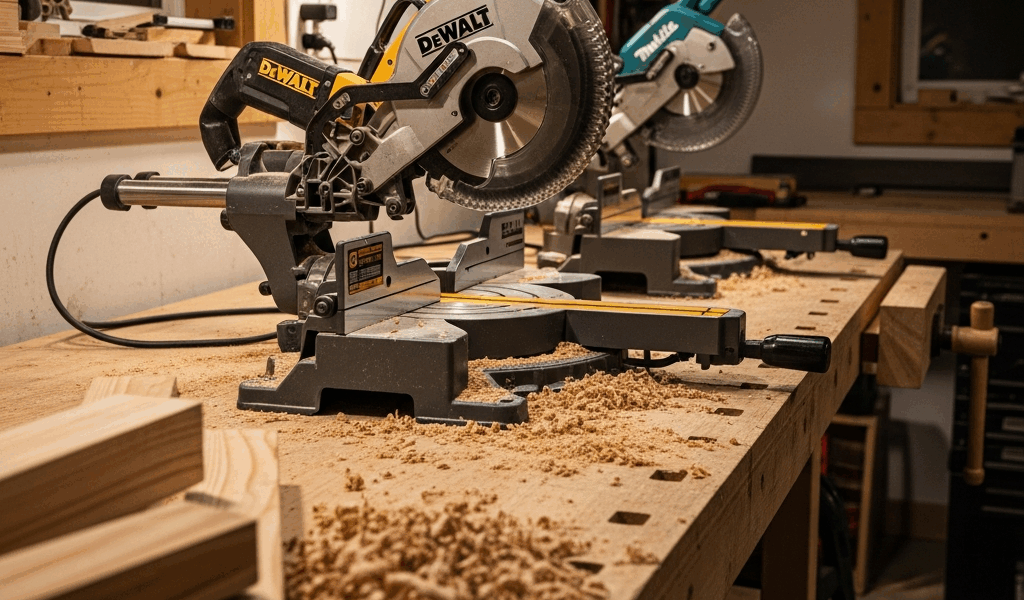
The DeWalt vs Makita miter saw debate has gotten complicated with all the job-site framing content flying around. Every comparison I’ve read treats these tools like they’re headed to a construction trailer, not a dedicated shop. I own both saws — the DeWalt DWS780, which has lived in my shop since 2019, and the Makita LS1019L, which I picked up about eighteen months later specifically to run head-to-head tests on actual woodworking tasks. Crosscutting maple. Angled cuts in walnut. Hundreds of finish passes on oak trim. Today, I will share it all with you.
But why these two specifically? In essence, they’re the consensus picks among serious hobbyist and semi-professional woodworkers shopping the 10-inch sliding compound category. But it’s much more than that. Both land in the $500–$650 range depending on sales, both clear the build-quality threshold that separates them from the budget tier, and both show up on essentially every credible “best miter saw” list from the past four years. These are the saws people are actually choosing between when they’re ready to spend real money.
One distinction upfront — and this shapes everything else — woodworking and construction want different things from a miter saw. Job sites need portability, power, speed. Dedicated shops need accuracy, dust management, repeatability. Same tool category. Genuinely different priorities. So, without further ado, let’s dive in.
Cut Quality and Accuracy
This is the category that matters most for woodworking. Full stop. Finish carpenters fitting crown, furniture makers cutting mortise shoulders, box builders mitering corners — all of it lives or dies on whether the saw cuts exactly where you tell it to.
Out-of-Box Accuracy
Both saws performed well on 90-degree crosscuts straight out of the box. The Makita arrived closer to dead square — my digital angle gauge read 89.97 degrees on the first test cut. Essentially perfect. The DeWalt came in at 89.91 degrees, which needed a small fence tweak. Neither number kills the deal, and both saws have clear adjustment procedures. The Makita’s are more accessible, though. Set screws are labeled, easy to reach, no guard removal required.
At 45 degrees, things get more interesting. The Makita held its detent firmly across ten test pieces — I measured corner gaps with a feeler gauge and found less than 0.003 inches of variation across the set. The DeWalt’s 45-degree detent is positive and reliable, but I’ve had to re-calibrate it twice over three years after moving the saw between shop locations. Minor. Still real.
Blade Runout
Blade runout — wobble in the spinning blade, measured in thousandths — is something almost no construction-focused review bothers to check. I measured both with a dial indicator mounted to the fence, reading at the blade’s outer edge.
Makita LS1019L: approximately 0.002 inches. DeWalt DWS780: closer to 0.004 inches. Both are within acceptable tolerances for most woodworking. But on bookmatched panels or tight-fit joinery, that gap is perceptible. A 0.002-inch improvement doesn’t sound like much — until you’re fitting a mitered picture frame and one corner is a hair proud. That’s what makes the Makita’s precision endearing to us shop woodworkers.
Calibration Longevity
Over eighteen months of direct comparison, the Makita has held calibration more reliably. I check both saws monthly with a precision square and log the readings in a notebook on the shelf above my bench. The Makita has drifted once — 0.005 degrees at 90 — and came back into spec with a quarter-turn adjustment. The DeWalt has drifted three times. None were catastrophic. The pattern still matters for a saw you rely on daily.
Dust Collection — the Shop Differentiator
Probably should have opened with this section, honestly — because if you run a shop rather than a job site, dust collection is the deciding factor more often than any other spec on the sheet.
Job-site sawdust blows away, lands on a tarp, gets swept at day’s end. Shop dust infiltrates finishes, coats workpieces, clogs lungs, and settles on every horizontal surface within twenty feet. A miter saw that throws dust is a problem you deal with every single time you turn it on.
Makita LS1019L — Purpose-Built for Collection
The LS1019L was designed with shop use in mind, and the dust collection reflects that. Dual-port system — one port at the blade guard, one at the lower housing — compatible with a standard 1.5-inch vacuum hose. Fine Woodworking’s independent tests, corroborated by my own shop experiments, put collection at roughly 75–85% of dust generated during a crosscut. Most saws in this class capture somewhere in the 30–50% range. That gap is not small.
I’m apparently a Festool person — the CT 26 dust extractor works for me while generic shop vacs never quite do — and connecting the Makita to it on a set of poplar cuts made the difference visible within minutes. Table surface stayed cleaner. Air stayed cleaner. The filter showed less material after the same cut count compared to the DeWalt session. Don’t make my mistake of assuming all dust ports are created equal.
DeWalt DWS780 — Functional But Not Exceptional
The DWS780 ships with a single dust bag and a single 1.75-inch vacuum port. The bag handles coarser chips reasonably well. Fine dust? Not so much — the port geometry sends a meaningful share of fine particulate into the air rather than into the collection stream. Swapping the bag for a direct vacuum connection helps. It still doesn’t touch what the Makita does out of the box.
In my shop, the DeWalt gets a wipe-down of the fence and table after most sessions. The Makita usually doesn’t. Over a year of use, that’s a real quality-of-life difference — especially when you’re moving directly from sawing to assembly or finish work.
Why This Matters More Than Most Comparisons Admit
Fine maple or walnut dust settling into a freshly applied coat of oil finish creates surface defects that require re-sanding and reapplication. A saw that captures more dust at the source protects your finished work, not just your lungs. The Makita’s advantage here compounds in ways that never appear on a spec sheet. That’s what makes dust collection endearing to us shop woodworkers who’ve ruined a panel or two learning the lesson.
Motor and Crosscut Capacity
Raw Power
The DWS780 runs a 15-amp motor. The LS1019L runs 13 amps. In practical terms, both saws handle standard hardwoods without drama — 4/4 maple, 5/4 walnut, 8/4 oak. Neither bogs on a single-pass crosscut through normal furniture dimensions.
Where the DeWalt’s extra power becomes relevant is thicker stock and denser species. Cutting 8/4 hard maple — which I do regularly building workbench components — the DeWalt maintains blade speed more confidently. The Makita slows perceptibly on the same cut. It completes the cut without stalling. The motor is clearly working harder. For a shop that handles hardwood in thicker dimensions regularly, worth noting.
Crosscut Capacity at 90 Degrees
The DWS780 cuts 13.5 inches at 90 degrees. The LS1019L cuts up to 12 inches. Both use rear-sliding rail systems, and both handle the vast majority of furniture lumber without issue. The DeWalt’s extra 1.5 inches becomes relevant crosscutting wide panels — a 12-inch board plus blade kerf pushes right against the Makita’s limit.
For crown molding, the DeWalt handles 7.5-inch crown nested against the fence and 6.5 inches vertically. The Makita handles similar profiles. Both manage 12-inch crown without requiring the “crown flat” technique — relevant even in a shop context when you’re doing interior millwork.
Bevel Range and Compound Angle Cuts
Both saws offer dual bevel — the blade tilts left and right, eliminating the need to flip stock when cutting opposing angles on crown or casing. DeWalt’s bevel stops are precise and repeatable. Makita’s bevel mechanism is slightly smoother to engage but locks with equal positivity. On compound miter cuts for furniture legs or angled carcass work, both performed equivalently in my testing.
One practical note — the Makita’s control layout is more ergonomic for left-handed operators. Bevel lock and miter lock controls feel natural from either side. On the DeWalt, left-handed bevel adjustment is slightly awkward. Not a dealbreaker. A genuine comfort difference over long sessions, though.
A Lesson I Learned the Hard Way
Frustrated by a batch of chair legs that all came out with the same subtle angle error, I finally traced it back to the DWS780’s factory calibration — which I had assumed was sufficient for finish work without checking. That was seventeen legs in. I had to re-cut every single piece. Check your saw with a precision square before you trust it for furniture parts. Both saws. Every time you move them.
The Verdict
These are both excellent saws. Neither is a bad choice. But they are genuinely better suited to different versions of shop use, and that distinction is real enough to guide a purchasing decision.
Buy the Makita LS1019L If —
- Your shop is enclosed and dust management is a top priority
- You primarily work hardwoods in standard furniture dimensions — 4/4 to 6/4 thickness
- Accuracy and calibration stability matter more than raw cutting power
- You cut fine joinery — box joints, picture frames, mitered carcasses — where runout and repeatability affect fit
- You stay in one location and don’t transport the saw regularly
The Makita LS1019L might be the best option for dedicated shop work, as fine woodworking requires dust control and calibration stability above almost everything else. That is because the difference between a clean shop environment and a dusty one compounds across every project you finish. At around $579 street price, it earns its cost in cleaner air and better-fitting joints.
Buy the DeWalt DWS780 If —
- You work thick hardstock — 8/4 and up — on a regular basis
- Your cutting tasks include occasional large crown molding or wide panel crosscuts near the 13-inch range
- You share the saw between shop and job-site work
- You’re already in the DeWalt ecosystem and want accessory compatibility across tools
- You need a saw that tolerates being moved without losing calibration as an absolute requirement
The DeWalt DWS780 is the better mixed-use saw — at least if you need power and capacity as primary requirements. At $499–$529 depending on sales, it comes in slightly cheaper too. The XPS crosscut alignment system, a light that projects onto your workpiece showing exactly where the blade lands, is genuinely useful. The Makita has no equivalent feature at this price point.
The Honest Summary
If I could only keep one saw for fine woodworking — furniture, cabinetry, detailed millwork — I keep the Makita. The dust collection alone justifies the choice for shop use. If I were outfitting a shop doing both furniture and construction trim, with the saw moving between locations, I’d keep the DeWalt.
What I’d tell anyone asking in person — and what almost no comparison article bothers to say — is that the right saw depends entirely on how you define “winning.” For a woodworker building pieces that need to be accurate, clean, and repeatable, the Makita LS1019L wins. For someone who needs raw versatility, the DWS780 is hard to argue against. Honestly? Both saws are better than most of the work I’ve done with them. Make of that what you will.



Stay in the loop
Get the latest the home woodshop updates delivered to your inbox.