
The Most Expensive Decision in Your Shop
A professional cabinet saw costs $4,000-$12,000. A high-end SawStop with a sliding table can run $15,000-$20,000. Premium European machinery—Felder, Hammer, SCM—reaches $30,000-$100,000+ for combination machines.
Meanwhile, a reliable jobsite table saw costs $400-$700. A decent contractor saw: $1,500-$2,500.
Which one is right for your shop? The answer depends on factors most woodworkers never think through systematically.
The False Economy of Budget Equipment
Cheap tools seem like smart business for a startup. You’re conserving capital, reducing risk, getting started with minimal investment. Except:
Time costs compound: A contractor saw requires more setup time for accurate cuts. Jigs that compensate for tool limitations take hours to build. Checking work twice because you don’t trust your equipment adds up.
Quality limitations show: Customer-visible results suffer when equipment can’t hold tolerances. The drawer gap that’s 1/16″ too wide, the miter joint that’s slightly open—these reflect on your craftsmanship even when the tool is to blame.
Safety concerns are real: Budget equipment often lacks proper guards, riving knives, and safety features. One accident can cost more than a lifetime of equipment upgrades.
Frustration affects output: Fighting your tools is exhausting. Woodworkers with reliable equipment produce more work with less stress.
The Trap of Premium Equipment
Top-tier equipment isn’t automatically the right choice either:
Capital tied up unproductively: $40,000 in a SawStop and Festool kit is $40,000 not available for marketing, rent deposits, or surviving a slow quarter.
Capabilities exceed requirements: If you’re building cutting boards and small furniture, you don’t need a sliding table saw with 12-foot crosscut capacity.
Maintenance complexity increases: More sophisticated equipment requires more sophisticated care. A simple belt-drive saw has fewer failure points than a precision European combination machine.
Depreciation reality: Premium equipment loses value the moment you buy it. That $15,000 saw is worth $8,000 used. Budget equipment depreciates less in absolute dollars.
The Framework for Equipment Decisions
\n\n
Brand is only one input. Our woodworking tool-brand comparison shows how battery platforms, service, precision, extraction, and total system cost fit into the decision.
1. Frequency of Use
How often will you use this tool?
- Daily: Justify premium investment. Table saw, jointer, planer.
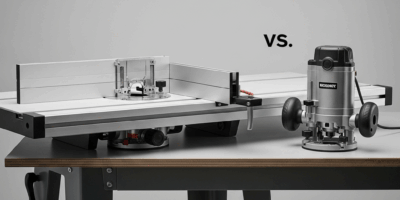
- Weekly: Good quality midrange makes sense. Bandsaw, router table.
- Monthly: Budget or used is often appropriate. Mortiser, drum sander.
- Yearly: Rent or borrow if possible. Spray booth, specialized jigs.
2. Revenue Attribution
Does this tool directly enable billing?
A table saw that cuts every project component earns its place. A specialized dovetail machine that you use twice a year might not, no matter how beautiful the dovetails.
3. Capability Gap
What can’t you do without this tool?
Sometimes equipment opens new markets. A wide-belt sander lets you take on larger panels. A CNC opens commercial work possibilities. Evaluate revenue potential, not just current needs.
4. Safety Considerations
Some tools justify premium spending purely on safety grounds:
- Table saws with flesh-detection technology (SawStop, Bosch REAXX)
- Proper dust collection (health is priceless)
- Quality hearing and eye protection
The Practical Approach: Staged Upgrades
Most successful shops follow this pattern:
Startup (Years 1-2):
- Quality contractor or hybrid saw ($1,500-$3,000)
- Used jointer and planer from reputable brands
- Basic router and handheld tools
- Functional dust collection
Established (Years 3-5):
- Upgrade to cabinet saw ($4,000-$10,000)
- New or premium used jointer/planer combination
- Quality bandsaw
- Dedicated router table
- Proper dust collection system
Professional (Years 5+):
- Specialized equipment for your niche
- Premium upgrades to daily-use tools
- CNC or other production equipment if warranted
- Redundancy for critical tools
Buying Used: Where the Deals Are
Used equipment offers compelling value in woodworking:
Best used buys:
- American-made cabinet saws (Powermatic, Delta Unisaw) from the 1980s-2000s
- Quality bandsaws with new blades and tuning
- Industrial jointers and planers
- Heavy cast-iron equipment generally
Buy new:
- Dust collectors (seals and filters wear)
- Equipment with electronics (CNC, digital readouts)
- Safety equipment (who knows how previous owners used it)
- Anything where technology has significantly advanced
Where to find used equipment:
- Estate sales and shop closures
- Craigslist and Facebook Marketplace
- Woodworking forums (Sawmill Creek, Woodworking Talk)
- Industrial auctions
- Used machinery dealers
The Total Cost of Ownership
Compare tools on total cost, not purchase price:
| Factor | Budget Saw | Premium Saw |
|---|---|---|
| Purchase price | $2,000 | $8,000 |
| Expected life | 10 years | 30 years |
| Annual depreciation | $200 | $267 |
| Maintenance/year | $150 | $100 |
| Time cost (setup, adjustment) | $500/year | $100/year |
| Total annual cost | $850 | $467 |
The premium saw actually costs less per year when you account for longevity and time savings.
Financing Equipment
When cash isn’t available, financing options include:
Equipment financing: Banks and specialty lenders offer equipment loans. 5-7 year terms, 6-12% interest typical. Equipment serves as collateral.
Business credit cards: 0% promotional periods can finance smaller equipment. Dangerous if you can’t pay before regular rates kick in.
Dealer financing: Major equipment dealers offer financing, often with promotional rates. Read terms carefully.
Equipment leasing: Monthly payments with option to buy at end. Can be expensive overall but preserves cash.
SBA loans: Small Business Administration loans offer favorable terms for equipment. More paperwork, better rates.
Questions to Ask Before Any Major Purchase
- Can I accomplish this with equipment I already own?
- Can I subcontract this operation instead of owning the capability?
- What’s the realistic payback period?
- Do I have the space, power, and dust collection for this tool?
- What’s the learning curve and will I actually use all features?
- How does this fit my five-year shop plan?
- Can I find this used in good condition?
- What’s the resale value if my plans change?
The “Good Enough” Standard
Not every tool needs to be best-in-class. Identify which tools directly impact customer-visible quality and which don’t:
Worth premium investment:
- Table saw (cut quality visible on every project)
- Jointer/planer (surface quality matters)
- Finishing equipment (final appearance)
Good enough is fine:
- Drill press (holes are holes)
- Shop vacuum (it cleans or it doesn’t)
- Most hand power tools
The Bottom Line
Equipment decisions define your shop’s capabilities, cash flow, and work quality for years. Neither buying the cheapest nor the most expensive option is automatically correct.
Think about frequency of use, revenue attribution, capability gaps, and total cost of ownership. Stage upgrades as your business grows. Buy used strategically. Invest heavily in daily-use equipment; be frugal with occasional tools.
The best equipment is what matches your current needs and growth trajectory—not what impresses visitors to your shop.

Stay in the loop
Get the latest the home woodshop updates delivered to your inbox.