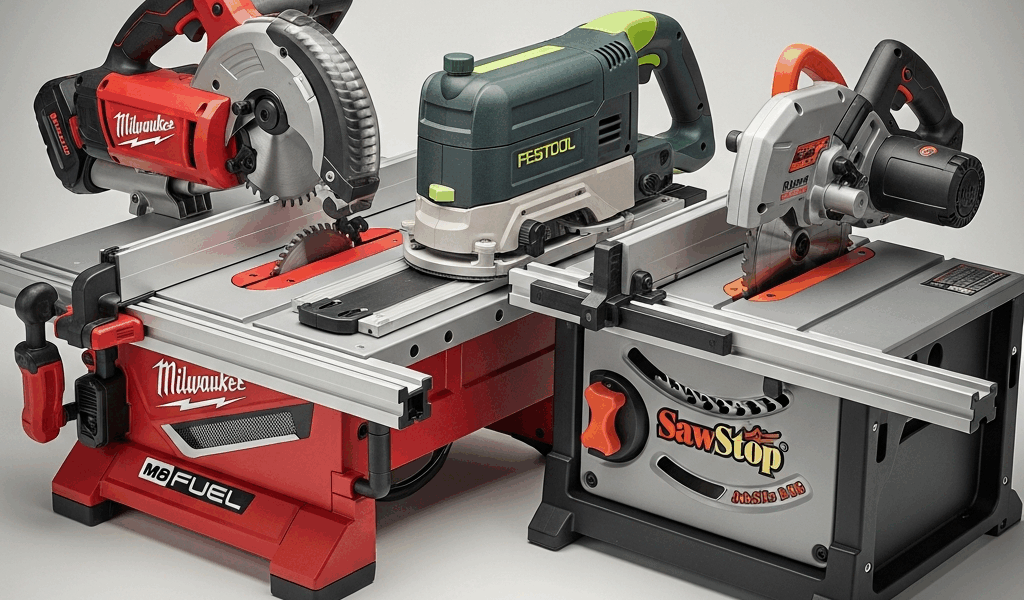
For a broader comparison that also covers DeWalt, Makita, Bosch, RIDGID, and Ryobi, start with our guide to the best tool brands for woodworking. This page stays focused on how Milwaukee, Festool, and SawStop serve different parts of a woodshop.
Power tool brand advice has gotten messy with all the contractor-focused noise flying around. Search “best power tool brands” and you’ll get the same article seventeen times — Milwaukee, DeWalt, Makita, maybe Bosch if the writer remembered Europeans exist. That ranking was built for electricians running wire at 7 a.m. in the cold, not for someone trying to get a glass-smooth finish on a walnut dining table. As someone who spent three years furnishing an entire house with hand-built furniture, I worked through the fundamentals of why brand selection in a woodworking shop is its own separate discipline. The contractor ranking isn’t wrong. It’s just answering a completely different question.
This article includes affiliate links. We may earn a commission at no extra cost to you.
Why the Contractor Ranking Is Wrong for Woodworking
Job site tools are optimized for three things: cordless runtime, physical toughness, and trade versatility. A Milwaukee M18 drill needs to survive a fall from a ladder onto concrete. A DeWalt circular saw needs to function in rain, sawdust, and freezing temperatures without throwing a tantrum. Legitimate requirements — just not woodworking requirements.
Woodworking optimizes for precision, surface quality, and dust management. That’s it. A random orbital sander that leaves swirl marks is worthless for furniture regardless of how indestructible its housing is. A track saw that drifts a millimeter over a 48-inch rip ruins expensive sheet goods. And dust — nobody talks about dust enough in general tool reviews. Fine wood dust is a carcinogen. It destroys finishes. It kills shop equipment over years of accumulation. Framers don’t care about dust extraction, so the contractor ranking ignores it entirely.
Four brands dominate woodworking specifically, and they barely overlap with the contractor top tier. Milwaukee still shows up — but for specific reasons that have nothing to do with job site toughness. Festool, SawStop, and Powermatic have zero relevance to a plumber and complete relevance to a furniture maker. Different craft, different framing.
Best for Cordless Shop Tools — Milwaukee M18 Ecosystem
Milwaukee wins the cordless category for woodworking shops. But what makes the M18 platform worth recommending here? In essence, it’s ecosystem depth — not toughness or brand legacy. But it’s much more than that. The M18 lineup currently covers the 2831-20 track saw, the 2838-20 router, a jigsaw, a detail sander, and multiple orbital sanders — all pulling from the same battery. In a shop where you’re constantly moving between tools, not hunting for the right charger is a genuine quality-of-life thing that compounds across a full work session.
The Milwaukee M18 Fuel track saw (2831-20) runs around $349 bare tool. The plunge action is smooth. The splinter guard actually works. For breaking down sheet goods before they go to the table saw, it’s the tool I reach for first — every time.
DeWalt FLEXVOLT competes closely and deserves an honest mention here. If you’re already in the DeWalt ecosystem — especially if you own the FLEXVOLT table saw or miter saw — staying put makes sense. The dual-mode voltage (20V/60V) is genuinely useful for high-draw tools like the DCS7485 table saw. Makita XGT is the right call for anyone already deep in that world, particularly builders who transitioned into a shop environment. Don’t start fresh with Makita just for the shop. But don’t abandon twelve batteries you already own, either.
Spare yourself the wrong turn I took. I bought a Ryobi cordless router early on — $89, trying to keep startup costs manageable. The collet wobble at speed was obvious within the first ten minutes. Cut quality was poor. Sold it within a month and ate the loss. The price gap between Milwaukee and budget cordless isn’t just branding — it’s the tolerance precision in the motor and collet assembly, which directly affects cut quality on wood surfaces in a way that drilling into studs never reveals.
Best for Precision Finishing — Festool
This is the piece to know up front. Festool is the brand that most separates serious furniture makers from everyone else, and it’s also the most misunderstood in terms of what you’re actually paying for.
The price is real — no point pretending otherwise. A Festool ETS 150/3 random orbital sander is $279. A comparable-looking Makita sander is $79. That’s not a rounding error. But what is Festool actually selling at that price? In essence, it’s dust extraction integration that works at the source, pad oscillation that genuinely eliminates swirl marks even at 220 grit, and the Systainer storage system — every Festool tool stacks into standardized interlocking cases that actually survive being moved around a shop. But it’s much more than that when you factor in the long-term ecosystem.
Frustrated by finish quality that never matched the tutorials despite hours of sanding prep, I finally bought a Festool RO 125 (around $349) paired with a Festool CT dust extractor ($549) and experienced an immediate, visible difference in surface quality — the kind you notice on the first panel, not after a learning curve. The air clarity improvement alone changed how long I could work in the shop without a headache.
The Festool TS 55 REQ track saw is $595 and is the benchmark for plunge track saw precision. The riving knife stays aligned. The dust port actually captures chips rather than performing theater about it. For anyone cutting hardwood veneered plywood or expensive solid lumber where a splintered cut edge means wasted material — and wasted money — the TS 55 earns its cost within a few avoided mistakes.
Festool’s real weakness is the proprietary ecosystem. Festool extractors work best with Festool tools. The hoses, fittings, and Bluetooth auto-start connectors are all Festool-specific. You’re not buying a sander — you’re entering a platform that will cost you more money over time. For serious woodworking, that platform pays real dividends. For casual weekend use, the math probably doesn’t work. That’s worth saying plainly.
Best for Safety — SawStop
SawStop exists in its own category entirely. It doesn’t really compete with Milwaukee or Festool — it answers one specific question: which table saw will not amputate your fingers when something goes wrong?
The flesh-detecting brake technology runs a small electrical signal through the blade. Wood doesn’t conduct. Skin does. Contact triggers a brake cartridge that stops the blade from 4,000 RPM to zero in under 5 milliseconds, simultaneously dropping the blade below the table surface. What you get is a nick, not an amputation. The system has documented thousands of prevented serious injuries since 2004. That’s not marketing copy — it’s a paper trail.
SawStop sells two configurations relevant to most woodworkers: the CNS (Contractor Saw) at around $1,599 and the ICS (Integrated Cabinet Saw) starting at $3,199. The CNS is the entry point for home shops. The ICS is the serious furniture-making workhorse — full cabinet enclosure, better dust collection, heavier cast iron tables that reduce vibration and improve cut quality at the surface level in ways you feel immediately.
The objection is always price. A comparable Powermatic cabinet saw runs $2,800–$4,200 depending on configuration, so SawStop at $3,199 isn’t actually out of range — it just feels like it is. When the safety system prevents one emergency room visit — which at U.S. hospital pricing runs $3,000–$30,000 for a hand injury — it has paid for itself in a single incident. For shared shop environments, schools, or anyone teaching family members to use a table saw, SawStop might be the best option, as woodworking requires proximity to a spinning blade at speed. That is because no amount of technique eliminates the possibility of a kickback at the wrong moment.
The Verdict — Build a System, Not a Brand Loyalty
The one-brand framing is the wrong question for woodworking. No single brand wins across all categories — that’s not a cop-out, it’s just how the tool landscape actually breaks down by specialty.
- Cordless handheld tools — Milwaukee M18 Fuel, or DeWalt FLEXVOLT if you’re already invested there. Pick one ecosystem and stay in it. Battery compatibility is the whole point.
- Sanding and track saw — Festool. Budget for the CT dust extractor at the same time. The sander without extraction is genuinely half the product.
- Stationary table saw — SawStop CNS for home shops, SawStop ICS for serious use. Powermatic PM2000B is the alternative if the safety premium doesn’t fit the budget right now.
- Stationary jointers, planers, drill presses — Powermatic and Jet compete closely here. The Powermatic 54HH jointer ($1,699) and 15HH planer ($1,999) are the category benchmarks worth measuring everything else against.
Most working furniture makers I know have landed in roughly this configuration — after years of trial, resale, and upgrades they’d rather forget. My own shop went through two budget table saws, three sanders I regretted buying, and one router bit incident that still makes me wince to think about. The brands above aren’t arbitrary preferences. They’re where woodworking-specific requirements for precision, dust control, and safety actually converge with tools that deliver on those requirements consistently.
That’s what makes this breakdown endearing to us furniture makers — it’s not about which brand sponsors the most YouTube channels. Generic power tool rankings aren’t wrong. They’re just not written for people who build furniture. Now you have the one that is.



Stay in the loop
Get the latest the home woodshop updates delivered to your inbox.