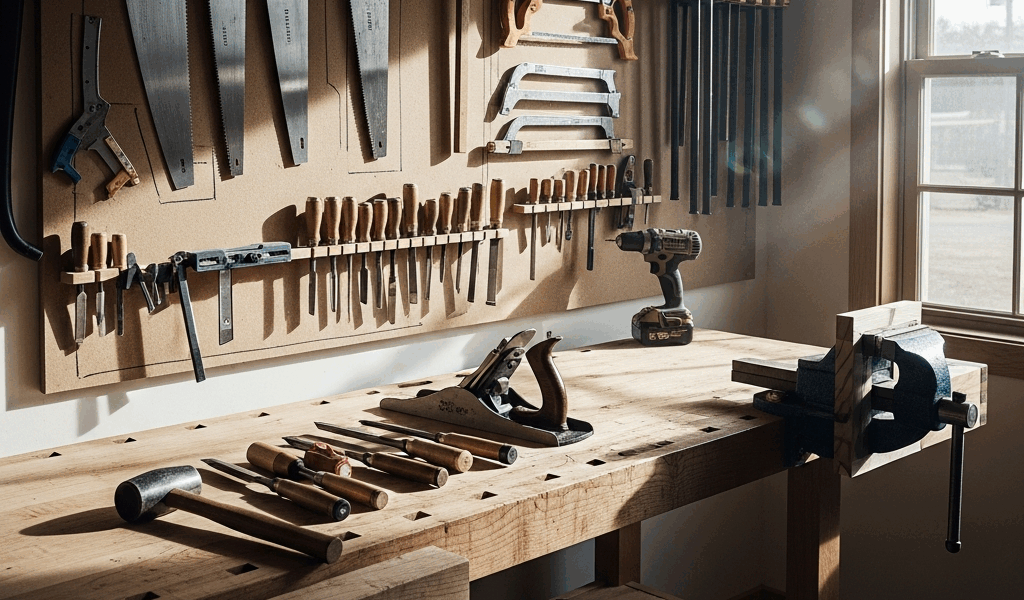
A disorganized workshop doesn’t just waste time — it kills motivation. You walk in planning to build something, spend 20 minutes looking for a chisel, and suddenly you’d rather do anything else. The fix isn’t buying more storage. It’s rethinking how you use the storage you already have.
Here are practical workshop organization strategies that actually stick, based on how woodworkers really work rather than how Instagram shops look.
The “Zones” Approach
Think of your shop in zones based on workflow, not tool type. Most woodworking projects follow a predictable sequence: rough dimensioning, joinery, assembly, and finishing. Your shop layout should mirror that flow.
Your miter saw and planer should be near your lumber storage. Your workbench and chisels should be close together. Your finish supplies should be near your drying area, ideally away from sawdust-heavy machines. When tools are arranged by workflow rather than category, you spend less time walking back and forth across the shop.
The French Cleat Wall
If you haven’t built a French cleat wall yet, it should be your next project. A French cleat system uses interlocking 45-degree bevels — one strip on the wall, one on the back of whatever you’re hanging. The beauty is flexibility. You can rearrange tool holders, shelves, and storage bins in seconds without drilling new holes.
Use 3/4-inch plywood ripped at 45 degrees. Space your wall cleats about 3 inches apart vertically. Then build custom holders for your specific tools — a rack for your chisels, a shelf for your hand planes, hooks for your clamps. Everything is visible, accessible, and easy to reorganize as your tool collection changes.
Cost for a full wall: about $40 in plywood and a Saturday afternoon.
The Cutoff Bin System
Every woodworker hoards cutoffs. The problem isn’t keeping them — many of those pieces genuinely are useful. The problem is having no system for finding the right piece when you need it.
Try sorting cutoffs into three bins: pieces under 12 inches (small parts, plugs, test pieces), pieces 12-36 inches (drawer parts, small panels), and anything longer (future project stock). Be ruthless about the small bin — if a piece is too thin, too short, or too warped to realistically use, it’s firewood. Review the bins every few months and clear out anything you’ve passed over multiple times.
Drawer Beats Shelf
Open shelves look great in photos but collect sawdust in real shops. For hardware, sandpaper, blades, and small accessories, drawers are almost always better. You can see everything at a glance when you open a drawer, and the contents stay clean.
Build simple plywood drawers for your workbench or a dedicated hardware cabinet. They don’t need fancy slides — wooden runners work fine for light-duty storage. Use dividers made from thin plywood or hardboard to keep screws, nails, and hardware separated.
The Mobile Base Strategy
If your shop is under 400 square feet — and most home shops are — mobile bases change everything. Put your table saw, planer, bandsaw, and drill press on locking casters. This lets you reconfigure the shop for different operations and push machines against the wall when you need floor space for assembly.
Commercial mobile bases work well, but you can also build your own from 2×4 frames with heavy-duty locking casters. The key is getting casters rated for the weight of your heaviest machine plus material. Undersized casters are a safety hazard.
The “Put It Back” Rule
No organization system survives laziness. The single most effective habit is putting every tool back in its designated spot immediately after use. Not at the end of the session — right then. It takes five seconds and prevents the slow entropy that turns an organized shop into a cluttered one.
To make this easier, every tool needs a visible, obvious home. Outlined shadow boards work for hand tools. Labeled bins work for accessories. If putting something away requires opening three containers or moving other tools, you’ll stop doing it. Make the “put it back” path as frictionless as possible.
A well-organized shop doesn’t require a big budget or a big space. It requires honest assessment of how you work and systems designed around your actual habits. Start with one zone this weekend, and build from there.



Stay in the loop
Get the latest the home woodshop updates delivered to your inbox.